
Boosting Service Efficiency: How the fErlang Loss Model Addresses Energy Constraints in Servers
In a world increasingly dependent on technology, efficient resource management is paramount, especially in sectors like telecommunications, healthcare, and manufacturing. A recent research paper by Elijah Kulikov, Eliezer Fuentes-Quezada, and Jamol Pender delves deep into this necessity by studying an energy-constrained Erlang-type loss system, highlighting how understanding server dynamics can revolutionize queue management in various industries.
The Challenge of Energy Constraints
As technology advances, so does the energy demand of servers—devices that help manage information and services. Traditional queue models assume unlimited service capacity, which is unrealistic. In this new model, each server has a finite battery that temporarily takes it offline when depleted. This leads to a scenario where customer demand might exceed service availability, resulting in blocking—a situation where incoming requests are denied service when all servers are busy.
Understanding the Model: Breaking Down Complexity
The researchers introduce a sophisticated queueing model known as the M/M/k/k queue. This model captures the essence of how many service-oriented systems, such as call centers and drone delivery services, operate under real-world constraints. Essentially, when all servers are occupied, customers are blocked and must wait until a server becomes available, which may be complicated by the server's need to recharge.
A key finding of the research is that the model characterizes the steady-state behavior of the queue with a two-dimensional Markov process, yielding a closed-form stationary distribution. This allows for precise calculations of performance measures, such as blocking probabilities and average occupancy—a huge advantage for sectors with limited resources.
Key Insights: Insensitivity to Time Distributions
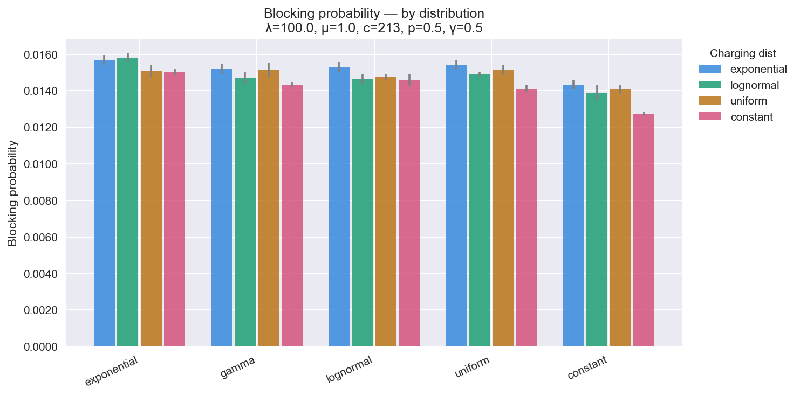
One of the standout conclusions of this study is the insensitivity property of the queue model. Surprisingly, the blocking probability depends only on the mean service time and charging time distributions, not on their full characteristics. This means that even as service times or charging methods vary widely—with different distributions of energy consumption and processing durations—the overall system performance can be reliably predicted using simple averages.
Practical Implications for Diverse Industries
The implications are significant. Whether in healthcare, where emergency departments are overwhelmed by patient inflow, or in telecommunications, where service quality is critical, understanding and implementing this model can lead to improved resource allocation and minimized customer wait times. For instance, drones in delivery networks can be optimized for energy efficiency, ensuring they can recharge promptly while still meeting service demands.
A Forward-Looking Perspective
As the paper concludes, exploring networks of loss queues and their dynamics could pave the way for future research, focusing on interconnected service nodes in urban landscapes or the implementation of AI to better manage resource-heavy operations. The authors suggest that developing models applicable to various arrival processes and nonstationary scenarios will be the next frontier in optimizing service efficiency in tech-dependent environments.
In summary, the innovative research on the fErlang Loss Model not only showcases a sophisticated understanding of queuing theory but also provides actionable insights that could transform efficiency in many critical sectors.
Authors: {Elijah Kulikov, Eliezer Fuentes-Quezada, Jamol Pender}




