
Breaking Down Barriers: How Active Turbulence Redefines Fluid Dynamics through Geometric Transitions!
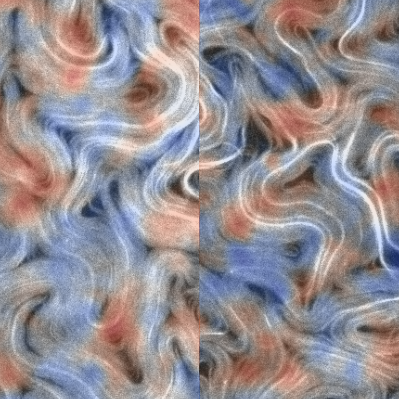
A groundbreaking study from researchers at the Niels Bohr Institute, University of Copenhagen, and other institutions has revealed a novel phase transition in non-equilibrium active fluids. This research challenges traditional views on phase behavior in fluid dynamics by defining the onset of fully developed active turbulence, driven by a critical threshold of activity in the system.
The Unconventional World of Non-Equilibrium Systems
In classical physics, phases and transitions are primarily understood through equilibrium statistical mechanics, including concepts like free energy landscapes and symmetry breaking. However, active fluids, which continuously inject energy into the system, operate outside these traditional frameworks. Instead of adhering to established phase rules, such as those seen in inertial turbulence, active fluids exhibit chaotic, vortex-dominated dynamics—the hallmark of what scientists are now calling "active turbulence."
Introducing a Critical Activity Threshold
The crux of this new research lies in identifying a critical activity threshold beyond which the system undergoes a significant transformation. Below this threshold, the vorticity structures in the fluids are fragmented, resulting in a disordered flow. Yet, as activity increases past this point, the system begins to exhibit organized behavior, with a network of vorticity lines becoming interconnected. This transition is characterized by the percolation of vortex centers into a rigid, system-spanning network, marking a clear distinction between the two states.
Experimental Evidence and Theoretical Framework
The researchers combined two experimental systems—a microtubule kinesin active nematic and dense bacterial suspensions—and backed their findings with large-scale simulations. Their analysis employed advanced statistical tools, including Schramm Loewner Evolution (SLE), to demonstrate that at high levels of activity, the nodal lines of the vorticity field align with critical percolation statistics, suggesting a universal behavior across various non-equilibrium systems.
Implications of Active Turbulence
Understanding active turbulence not only has theoretical implications for physics but also extends to functional applications in biological systems and materials science. The collective organization at the transition threshold provides insights into how fluids transport matter and energy, which could influence everything from drug delivery systems to the behavior of living tissues.
This research not only advances our fundamental knowledge of fluid behavior but prompts a re-evaluation of the principles governing non-equilibrium systems. The identification of clear thresholds for phase transitions offers an accessible framework for future studies in various disciplines.
As we delve deeper into the world of active turbulence, the implications for physical and biological applications appear limitless, paving the way for innovative solutions to complex challenges in science and engineering.
Authors: Lasse Bonn, Tianxiang Ma, Olga Bantysh, Wei Feng, Martin Cramer Pedersen, Guangyin Jing, Jordi Ignés-Mullol, Francesc Sagués, Nuno A. M. Araujo, Amin Doostmohammadi.


