Breaking Ground in Astrophysics: How Gravitational Waves Are Revolutionizing Our Understanding of Star Formation
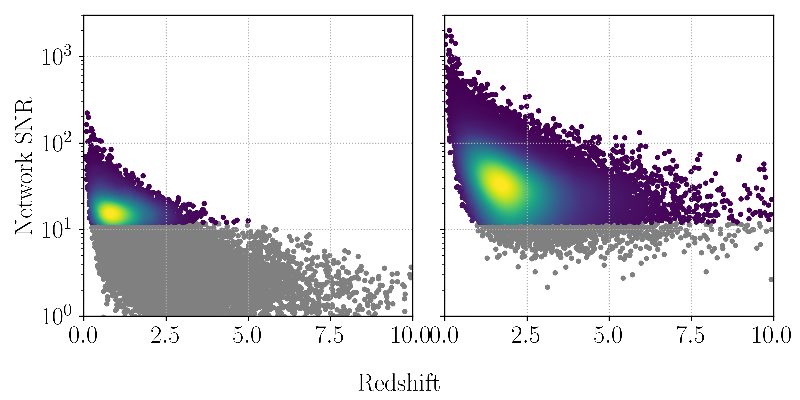
In a groundbreaking study, researchers from the Gravity Exploration Institute at Cardiff University unveil a novel approach to measuring the star formation rate density (SFRD) across cosmic time. By combining gravitational wave observations from the LIGO detectors with existing electromagnetic probes, they are poised to provide unprecedented insights into the evolution of galaxies and the large-scale structure of the universe.
The Challenge of Mapping Star Formation
Traditionally, the SFRD has been measured using electromagnetic observations, which can often misinterpret data due to factors like initial mass function and dust extinction. This study proposes utilizing gravitational waves, particularly from binary black hole mergers, as a complementary method for high-redshift measurements. This innovative approach could resolve longstanding uncertainties surrounding the peak of SFRD, particularly during the pivotal eras of galaxy formation.
A New Methodology with Gravitational Waves
The researchers developed three distinct population models to analyze the redshift evolution of binary black hole merger rates. By simulating scenarios with current LIGO detectors and next-generation instruments like Cosmic Explorer and Einstein Telescope, they demonstrated that even with the current detectors, it is possible to achieve high-precision estimates of the star formation peak, and that future detectors could substantially refine these measurements.
Impressive Findings and Future Implications
One key finding is that with a year of observations, LIGO detectors operating at A# sensitivity can constrain the peak of the merger rate with an accuracy of ±0.1. More excitingly, future networks could result in a precision of ±0.02, offering a clearer picture of how star formation has evolved over time. This is essential for understanding cosmic history and could have implications for theories surrounding dark matter, the formation of heavy elements, and the growth of massive black holes.
Contributions to Astrophysics
This research highlights the potential of gravitational wave astronomy to advance our understanding of star formation processes. By linking gravitational wave data to galaxy surveys, scientists can glean insights into metallicity, heavy elements, and structure formation. This synergistic method promises a richer, more nuanced understanding of the cosmos.
In conclusion, as gravitational wave observatories improve their sensitivity, the potential to accurately map the heights of star formation and understand its intricate relationship with the evolution of the universe becomes an attainable goal. This study sets a new precedent for leveraging gravitational waves in astrophysics, paving the way for future discoveries.
Authors: Divyajyoti, Stephen Fairhurst, Mark Hannam, Mukesh Kumar Singh

