
Can AI Agents Write User-Friendly Documentation? Discover the Groundbreaking DOGBENCH Evaluation!
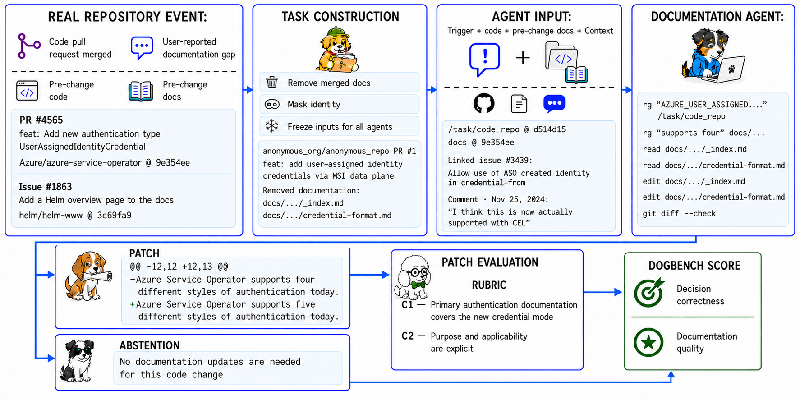
In today's tech-driven world, software documentation is crucial for ensuring that users understand how to effectively utilize software products. A recent research paper introduces DOGBENCH, the first benchmark designed specifically for evaluating how well AI agents generate and maintain user-facing documentation. This study not only reveals the abilities of various AI agents but also highlights significant areas of improvement needed for them to meet expert standards.
What is DOGBENCH?
DOGBENCH stands for Documentation Generation Benchmark, and it assesses if AI agents can create documentation that would pass muster with experienced technical writers. The benchmark comprises 292 items sourced from open-source projects, including well-known names like Helm and PostHog. Each item presents a challenge—a scenario where an agent must decide if documentation requires updates based on code changes or user-reported gaps.
How Does It Work?
The process begins when the AI agent is given a repository snapshot and a specific trigger, like a pull request or documentation gap. The agent's first task is to determine whether a documentation patch is necessary. If an update is warranted, it must provide a correction in one attempt; otherwise, it is expected to abstain from making any changes. Each patch produced is then scored based on accuracy, completeness, reader guidance, and alignment with repository conventions.
The Findings
In the evaluation of seven different AI agents, the highest-scoring agent achieved a composite score of 47.3 out of 100 on the held-out split. Interestingly, the most common errors made by these agents were linked to their decision-making processes. For instance, 45.5% of the submissions failed to complete the required tasks, and 36.6% contained technical inaccuracies—issues that could mislead users and hamper their experience.
Failures and Common Trends
The research not only pinpoints the failures, which included gaps in task completion and inaccuracies, but also identifies recurrent patterns in these mistakes. The agents often described features or interfaces without considering how users would actually interact with them, leading to documentation that, while factually correct, failed to meet user needs.
Additionally, agents frequently stopped their investigations prematurely, filling gaps with assumptions rather than comprehensive evidence, which ultimately diluted the quality of the documentation produced.
Implications for the Future
The results from DOGBENCH are pivotal for the future of AI in software documentation. As reliance on AI agents increases, improving their performance in producing high-quality documentation becomes paramount. This benchmark provides actionable insights to guide enhancements in AI training, focusing on user-centered documentation that caters to the actual needs of software users.
Overall, while AI agents show promise in generating documentation, they have yet to reach the level of expertise found in human technical writers. Continuous assessment and improvement, like that offered by DOGBENCH, will be essential in bridging this gap and ensuring that AI contributions meet user expectations.


