
Cosmic Revolutions: Exploring the Novel Dynamics of Dyonic Rotating Black Holes Surrounded by Quintessence
In a groundbreaking study, researchers M. D. de Oliveira and Alexandre G. M. Schmidt have unveiled a new metric that describes a unique type of black hole—a dyonic rotating cosmological black hole surrounded by quintessence. This innovative model not only incorporates electric and magnetic charges but also explores the effects of dark energy on the black hole's structure and behavior. The findings represent a significant advancement in our understanding of astrophysical black holes and their interactions with the universe.
What is Quintessence in Black Holes?
Quintessence is a theoretical form of dark energy that changes over time and is believed to drive the accelerated expansion of the universe. In this study, the authors expand upon previous black hole solutions by integrating quintessence into the model of a rotating black hole. By doing so, they challenge conventional models that treat the cosmological constant merely as a geometric feature and instead consider it as matter affecting the spacetime dynamics.
The Newman–Janis Algorithm: A Path to Rotation
The researchers employed the Newman–Janis algorithm to introduce rotational effects into a Schwarzschild-type black hole, thus enabling the exploration of complex higher-dimensional solutions. The algorithm allows the researchers to effectively manage ambiguities that often arise when transitioning from static to rotating solutions in general relativity, making the new metric both robust and reliable.
Key Findings: Event Horizons and Ergospheres
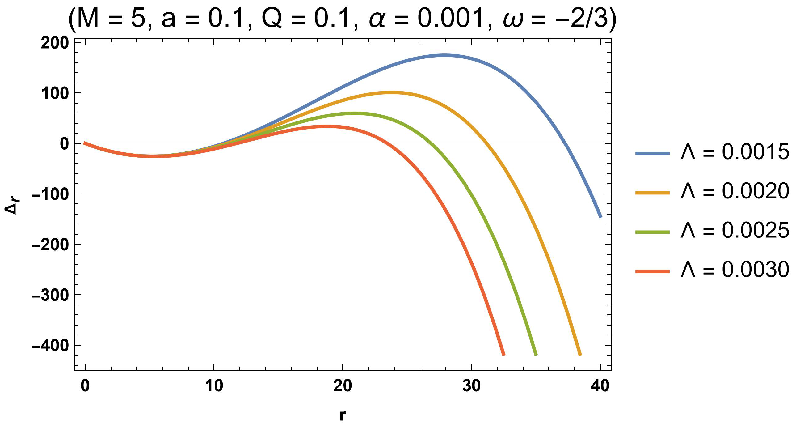
One of the pivotal findings of this research is the detailed examination of the event horizon conditions and the ergosphere—regions surrounding the black hole where the gravitational effects are so strong that particles cannot remain stationary. By analyzing how the cosmological constant and quintessence parameters influence these features, the study opens doors for further exploration of black hole thermodynamics and their astrophysical implications.
Notably, the researchers noted that both event horizons are impacted by the energy contributions from quintessence and cosmological constants, reducing their effective size as these parameters increase. This finding alludes to possible observational characteristics that could be detected in massive black holes.
Implications for Modern Cosmology
By offering a new perspective on the interplay between black holes and dark energy, this paper contributes significantly to the fields of cosmology and gravitational physics. The implications of this study suggest that black holes are not merely cosmic voids but may actively participate in shaping the universe's evolution through their interactions with dark energy.
The derived equations and metrics could pave the way for new avenues of research, particularly in understanding the dynamics of black holes in the context of gravitational waves and cosmic structure formation.
Conclusion: A Step Towards Understanding the Universe
This research presents a compelling convergence of general relativity and cosmological models, integrating advanced mathematical techniques to yield insights into the complex nature of black holes and their role in cosmic evolution. As astrophysics progresses, the novel insights from this study may very well guide future explorations of the universe's most enigmatic structures.
Authors: M. D. de Oliveira, Alexandre G. M. Schmidt




