
Crafting the Future of Soft Robotics: How Calcium-Controlled Tcb2 Networks Offer New Insights!
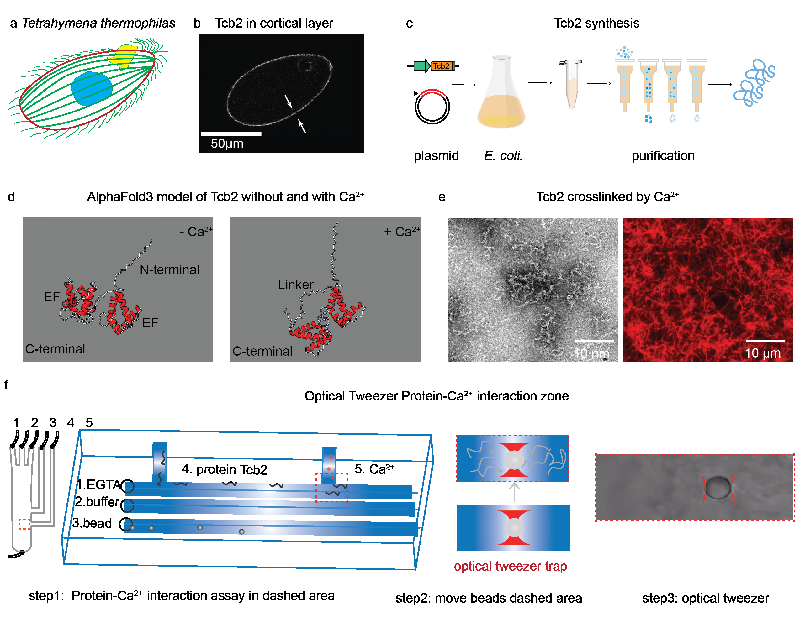
In an exciting breakthrough, researchers from Georgia Tech and various prominent institutions have delved into the mechanics of protein-based materials. Their recent study uncovers how calcium ions modulate the mechanical properties of Tetrahymena calcium-binding protein (Tcb2) networks, revealing a tunable system for understanding the foundational elements of soft materials and their potential applications in soft robotics.
The Calcium Connection
Tcb2, a calcium-binding protein, participates in generating contractile networks crucial for biological processes. This research advances the understanding of how varying calcium concentrations—ranging from 1 mM to 100 mM—affect the stiffness and elasticity of these protein networks. Surprisingly, increasing calcium concentration can amplify the network's effective stiffness by nearly two orders of magnitude, transforming it from a fluid-like material to a more solid-like structure capable of significant mechanical resilience.
Innovative Experimental Techniques
The researchers employed a combination of optical tweezers and microfluidics to precisely manipulate and measure the mechanical properties of Tcb2 networks. This innovative approach allowed for systematic tuning of calcium concentrations and real-time observation of how these changes impact the network's structure and behavior. By using optical tweezing techniques, they could monitor the forces exerted on beads embedded in the networks, thereby quantifying the networks' elastic and viscous responses.
Key Findings on Network Mechanics
One of the standout discoveries involves the networks’ recoil behavior. During recoil assays, researchers tracked how beads embedded in the Tcb2 networks moved after being displaced by the optical trap. At higher calcium concentrations, more elastic energy was stored and released, suggesting that the networks are not only responsive but can also rapidly release built-up stress. This finding is critical as it indicates the presence of elastic memory in these proteins—similar to characteristics observed in more complex, motor-driven systems.
Real-World Implications and Future Research
The implications of this research are significant for the fields of bioengineering and soft robotics. The tunable nature of Tcb2 networks offers possibilities for developing new materials that can adapt to different mechanical requirements. As artificial intelligence and robotics increasingly rely on biologically-inspired materials, understanding these protein networks could lead to innovative applications in areas ranging from flexible electronics to responsive drug delivery systems.
In conclusion, this research highlights the importance of protein mechanics and calcium's role in modulating these properties. The findings not only pave the way for future explorations in biophysics but also hold the promise of enhancing numerous technological applications by mimicking the intelligent design observed in nature.
Authors: Xiangting Lei, K. R. Prathyusha, Carlos Floyd, Jerry Honts, Saad Bhamla


