
Decoding Drosophila Vision: How Orientation Maps Emerge in the Absence of a Cortex
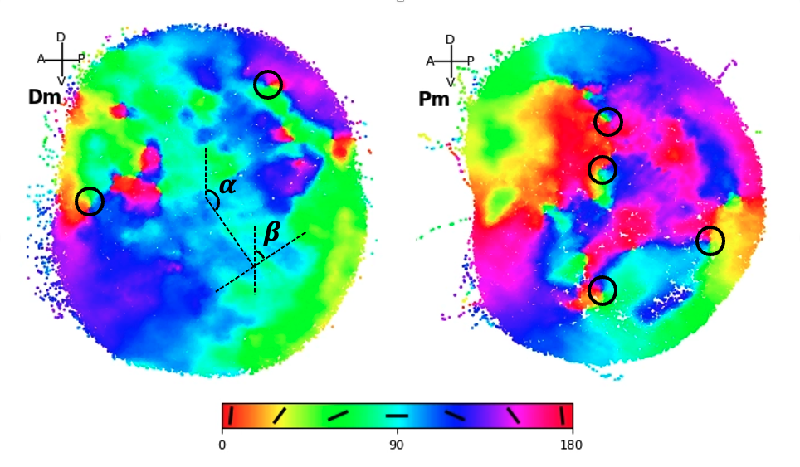
In a recent study, researchers uncovered how the humble fruit fly, Drosophila melanogaster, creates structured vision representations despite lacking the complex cerebral architecture of mammals. By utilizing advanced simulations based on a complete fruit fly brain connectome, the team's findings challenge conventional views on vision processing and open new avenues for understanding visual systems across species.
Understanding Orientation Mapping
The concept of orientation maps—where groups of neurons are organized based on their preferred edge orientations—has long been associated with mammals, specifically the visual cortex. However, the Drosophila brain operates differently. In this groundbreaking research, scientists found that coherent orientation maps can still emerge from the fly's distinct neural architecture, which is not layered like that of vertebrates.
Key Findings from the Research
The study set out to simulate the visual responses of neurons in the Drosophila optic lobe, revealing that when subjected to oriented visual stimuli, neurons exhibited organized spatial responses that resemble orientation maps. This means that even without the traditional cortical structures found in larger brains, Drosophila can process visual information effectively, allowing them to respond accurately to their environment.
The research revealed that even when certain neuron types, specifically Dm3 and Dm15, were included in the analyses, the general spatial organization remained coherent. This indicates a robust network for visual processing. In fact, the inclusion of these neurons helped illustrate a stratified organization within the optic lobes, enhancing understanding while preserving the overarching principles of orientation mapping.
The Implications of These Discoveries
These findings are significant not only because they reveal aspects of the visual system in an invertebrate but also because they suggest that orientation mapping might arise from universal computational principles. This implies that similar structures could evolve independently in different species, furthering our understanding of how visual systems adapt across the animal kingdom.
As researchers mine further into the complexities of the Drosophila brain, they draw attention to its potential role as a model for bio-inspired artificial vision systems—one that could be lightweight and energy-efficient, suitable for autonomous applications.
Future Research Directions
This study highlights the importance of targeted ablation analyses, which demonstrated the critical roles certain neurons play in orientation selectivity. By silencing specific neuron types, scientists can investigate how visual processing shifts, providing deeper insights into the mechanics of sensory integration. Continued exploration in this field will likely yield fascinating revelations about not just Drosophila, but potentially other species as well.
Overall, the research establishes a foundational understanding of visual systems that could bridge gaps between biological and artificial intelligence applications, making it a cornerstone for future studies in vision processing.
Authors: Jia-Nuo Liew, Shenghan Lin, Bowen Chen, Wei Zhang, Xiaowei Zhu, Wei Zhang, Xiaolin Hu




