
Decoding the Inner Workings of AI Judges: How LLMs Evaluate Summaries Through Mechanistic Analysis
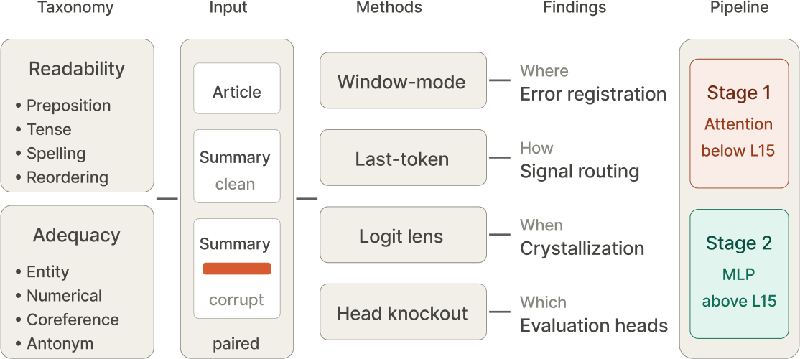
In the burgeoning field of natural language processing (NLP), understanding the mechanisms by which large language models (LLMs) evaluate the quality of generated content has emerged as a vital area of research. A new study, “Beyond Scores: Understanding LLM-as-a-Judge Mechanisms in Summarization Evaluation”, authored by Himil Vasava and Ming Jiang from the University of Wisconsin-Madison, delves into the intricate internal workings of LLM-based evaluators, shedding light on how these models score the quality of summarizations.
The Motivation Behind the Study
As LLMs are widely utilized in tasks ranging from text summarization to dialogue generation, it is crucial to comprehend not only what these models assess but how they arrive at their conclusions. The authors of this study question whether LLMs pinpoint specific quality defects in generated summaries or merely produce ratings based on learned patterns from their training data. The objective is to reveal the internal mechanics at play during summary evaluations.
A Novel Analytical Framework
To tackle this challenge, Vasava and Jiang developed an innovative perturbation taxonomy consisting of eight unique error types focused on two key dimensions of summarization quality: Readability and Adequacy. This structured approach also included the creation of paired clean and corrupted summaries, allowing for precise tracking of how modifications impact ratings.
The researchers employed advanced methods, such as causal tracing and attention-head knockout analyses, on two LLM-based evaluators—the Themis model and Prometheus—to ascertain where and how scores were computed within the model architecture.
Key Findings: The Structure of Evaluation
The study's findings revealed that both evaluators employ a coherent two-stage evaluation pipeline. In the lower layers of the model (below layer 15), attention mechanisms engage in local error comparisons and route the results to the final input position. In the upper layers, a multi-layer perceptron (MLP) processes these inputs to produce the final score, with significant decisions crystallizing in a specific upper layer (L=26 for Themis and L=25 for Prometheus).
Moreover, the process of error identification varies depending on the nature of the error. For instance, assessments related to readability errors utilize a broader syntactic context in their analysis, while adequacy errors remain concentrated on specific altered tokens. This nuanced approach suggests that the evaluators deploy distinct strategies tailored to the type of error being assessed.
The Impact of Fine-Tuning
Interestingly, the study also highlights that fine-tuning the models does not create an evaluation pipeline from scratch. Instead, it modifies an existing framework, refining how the models handle inputs and leading to a more systematic rating process. This discovery emphasizes the potential for targeted interventions in improving evaluator behavior without comprehensive model retraining.
Conclusion: Insights for Future Model Development
This pioneering research not only unveils the operational intricacies of LLMs in assessing summarization quality but also sets the stage for enhancing the robustness and interpretability of these evaluators. The implications of this work extend far into the future of NLP, emphasizing a continually evolving landscape where understanding model inner workings can lead to more reliable AI applications.
For those interested in exploring this further, the authors have made the source code and data available publicly, presenting a valuable resource for additional research into the mechanistic understanding of LLM-based evaluators.
Authors: Himil Vasava, Ming Jiang
Contact: {vasava, ming.jiang}@wisc.edu




