
Discovering the Conformally Invariant Geodesic Metric: A Breakthrough in Understanding CLE4
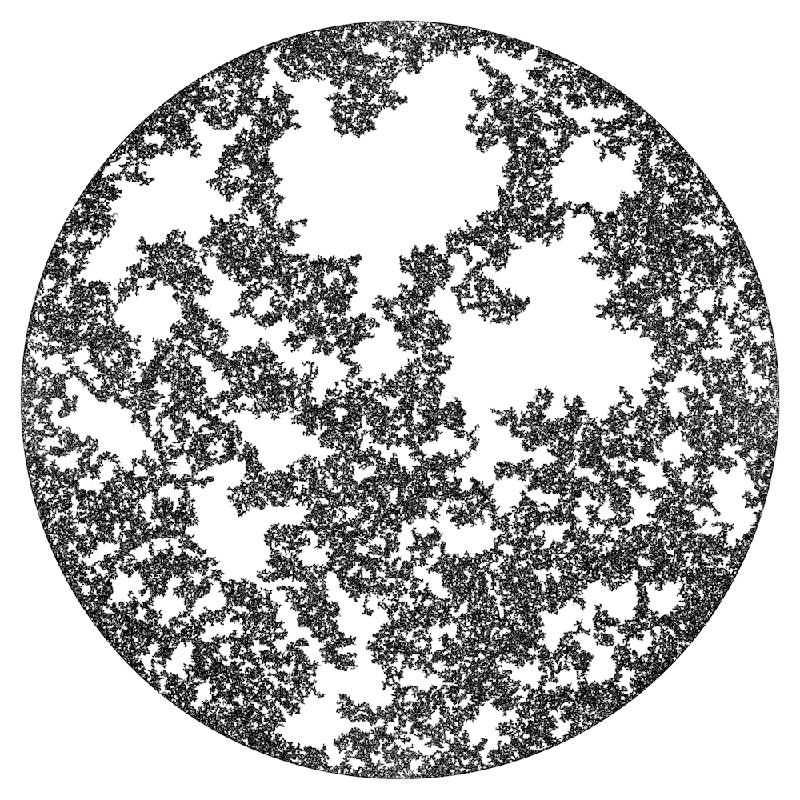
Researchers Emmanuel Kammerer, Konstantinos Kavvadias, Jason Miller, and Yi Tian have unveiled a significant development in the study of Conformal Loop Ensembles (CLE). Their paper, titled "The Conformally Invariant Metric on CLE4 I: Subsequential Limits of the Non-Simple CLE Graph Metric," explores the uniqueness of a conformally invariant metric associated with the CLE with parameter κ=4. This critical value is pivotal, as it dictates the nature of the loops, which are simple and non-intersecting within the specified domain.
Understanding CLE and Its Importance
Conformal Loop Ensembles are random collections of non-crossing loops that emerge in the study of 2D statistical models and quantum gravity. The ensemble with the critical value κ=4 is thought to provide insights into important physical phenomena, such as phase transitions and critical systems.
This research focuses on constructing a local, geodesic metric that retains conformal invariance. The authors demonstrate that the loops generated by the CLE4 structure can cleverly map to a geodesic metric, illuminating fundamental relationships between geometry and probability in statistical physics.
The Innovative Approach to Metric Construction
The primary objective of the research is to show that the loops of a CLE4 can consistently define a metric where the growth of distance from the domain boundary coincides with the uniform exploration previously described by researchers Werner and Wu. This adaptability relies heavily on a unique process of renormalization, capturing subsequential limits of loop distances as the parameter κ approaches the critical limit of 4.
This renormalization is essential since traditional metrics fail to accommodate the intricate nature of kernel distance needs when κ reaches 4 and beyond, thus challenging existing frameworks in mathematical physics.
Key Findings and Their Implications
Among their findings, the authors establish that as κ approaches 4, these distance metrics converge to show that the space retains local properties, allowing for a deepening understanding of geometric behavior under random fluctuations associated with quantum states. Notably, they set a stage for future studies to use this framework for exploring additional dimensions of CLE, including the implications of various graph distance measures in two-dimensions.
The lemmas and propositions laid out throughout the paper, especially correlation to conformal invariance, point toward promising expansions in this domain of research. By applying their innovative metric treatments, future researchers might explore other critical points significantly impacting quantum gravity theories and statistical mechanics.
Potential Applications and Future Research
The ramifications of this work extend beyond pure mathematics, suggesting new pathways to explore in quantum physics, particularly in understanding phenomena like percolation and phase transitions. As research in CLE and associated metrics continues to evolve, the authors' comprehensive framework will likely catalyze further discoveries in the relationships between algebraic structures, kernel metrics, and physical models.
In the subsequent parts of this research series, the team aims to delve deeper into the unique properties of the limit metric they constructed while conducting a thorough examination of its axiomatic foundations and informing probabilistic models, thus laying a groundwork for future explorations in this vibrant field.




