
Discovering the Future of NLP: How Drift Inspector Maps the Evolution of Scientific Contributions!
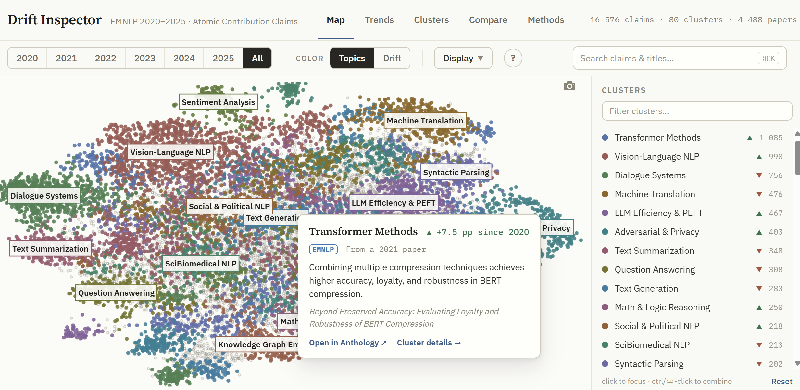
A new research paper introduces Drift Inspector, an innovative tool that allows users to explore and measure how scientific fields, particularly Natural Language Processing (NLP), evolve over time. By focusing on Atomic Contribution Claims (ACCs), Drift Inspector sheds light on the actual contributions made by research papers, distinguishing them from discussions and motivations that often intertwine in academic literature.
The Challenge of Understanding Scientific Progress
In a rapidly expanding field like NLP, with thousands of papers published each year, understanding what a paper truly contributes can be challenging. Traditional systems often conflate the background discussions with the actual scientific contributions made by researchers. This means that insights into whether certain methods or ideas are growing or declining in relevance become obscured by buzzwords and repetitive themes.
What is Drift Inspector?
Drift Inspector is an open-source tool that tackles this problem head-on by extracting ACCs from research abstracts. It generates a visual map that clusters these claims from various years, revealing trends and shifts in research focus. This allows researchers to see not just what is being published but also the evolution of specific contributions within the field.
How Does Drift Inspector Work?
The system operates by mapping each abstract to a unique set of ACCs—self-contained propositions focused on contributions without distractions from background or meta-language. After extracting these claims, the tool uses advanced machine learning techniques and clustering methods to visualize how certain research themes have emerged or declined over recent years. For example, an application to the EMNLP conference data showed a clear shift from traditional NLP tasks to newer areas dealing with Large Language Models (LLMs) and multimodality.
Empowering Researchers and Conference Organizers
This tool serves various audiences, including researchers looking to position their work, conference organizers monitoring trends, and those studying the science of science who wish to understand scholarly evolution quantitatively. Drift Inspector provides a clear, interactive interface that enables users to filter and analyze trends over time, connect clusters to specific papers, and even compare different research subsets.
Implications for the Future of Research
With its ability to provide real, data-driven insights into the progression of scientific discourse, Drift Inspector is poised to reshape how researchers approach literature reviews, grant applications, and even classifying their own work’s relevance. The potential to map and visualize scientific drift offers a significant step toward clearer, more effective academic engagement.
Conclusion: A New Era in Scientific Analysis
Drift Inspector represents an important breakthrough in the way scientific contributions are measured and understood. By favoring empirical data over narrative, it aligns researchers with the true trajectory of their fields, fostering innovation and clarity in a landscape that often feels overwhelming. As we continue to explore and understand new technologies, tools like Drift Inspector may prove invaluable in guiding research directions and priorities.
Authors: Vsevolod Karimov, Stepan Ostarkov, Anastasia Poroshina, Anatoly Frolov, Alexander Panchenko.


