
Exponential Speedup in Polarization Stabilization: A Leap Forward for Long-Distance Quantum Networks
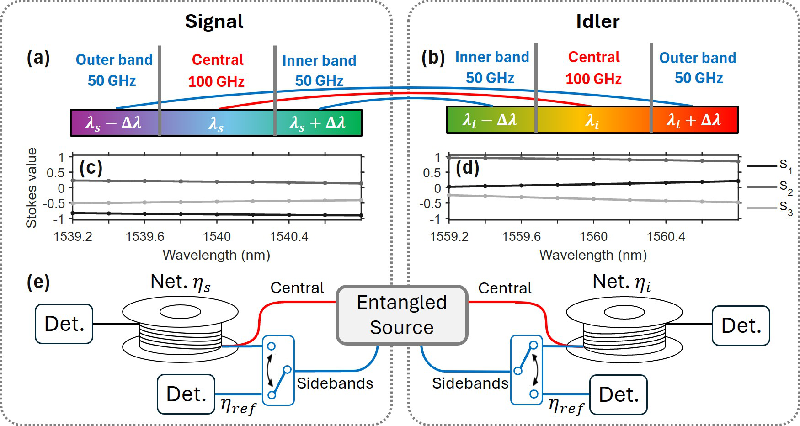
Recent research led by a team from the National University of Singapore has introduced a groundbreaking method to enhance polarization stabilization in long-distance dense wavelength-division multiplexed (DWDM) quantum networks. This innovative technique achieves an exponential reduction in acquisition time for polarization feedback, which is crucial for maintaining entangled photon distributions over extensive fiber networks. The findings promise significant advancements in quantum communication technologies.
A Key Challenge: Polarization Stabilization in Quantum Networks
Polarization plays a vital role in quantum communication, particularly in distributing entangled states necessary for applications like quantum key distribution and teleportation. However, maintaining stable polarization over long distances poses a significant challenge. External factors such as temperature fluctuations and mechanical stress can distort polarization states within fiber cables, causing instability in the quantum signals being transmitted.
Revolutionary Two-Stage Method
The new polarization stabilization method combines two innovative approaches: wavelength-bracketed polarizations and switch-enabled path decompositions. This combination allows for precise tracking of polarization changes without needing to interrupt the ongoing transmission of quantum signals, thus eliminating downtime typically required for calibration processes.
The technique involves using entangled-photon sidebands located at spectrally adjacent wavelengths. These sidebands serve as real-time feedback channels, measuring the polarization response of the primary entanglement channel while it continues its operation uninterrupted. This innovative approach transforms the traditional product loss scaling of long-distance feedback into a significantly more manageable sum loss scaling, expediting the calibration process.
Continuous Operation and High Fidelity
In a practical test conducted over fiber lengths of 133 kilometers, the system demonstrated impressive results, achieving a continuous closed-loop stabilization for over 24 hours without using classical reference light sources. Throughout this period, the central entanglement fidelity remained remarkably high at an average of 95.1%. This consistency illustrates not only the method's reliability but also its scalability for real-world applications in extensive quantum networks.
The Future of Quantum Communication
This innovation marks a significant step towards realizing more robust quantum communication infrastructures, especially as global demands for secure information transfer increase. The integration of such polarization stabilization techniques within existing DWDM systems could ultimately lead to faster, more reliable, and secure quantum networks.
Overall, this research lays the foundation for a new generation of quantum communication technologies that may transform our approach to networking and information security, pushing the boundaries of what is currently achievable in quantum systems.
Authors: Jinyi Du, En Teng Lim, Xingjian Zhang, Hongwei Gao, George F.R. Chen, Dawn T. H. Tan, Alexander Ling




