
From Chaos to Harmony: How Topological Oscillators Bridge Stochasticity to Synchronization in Circadian Rhythms
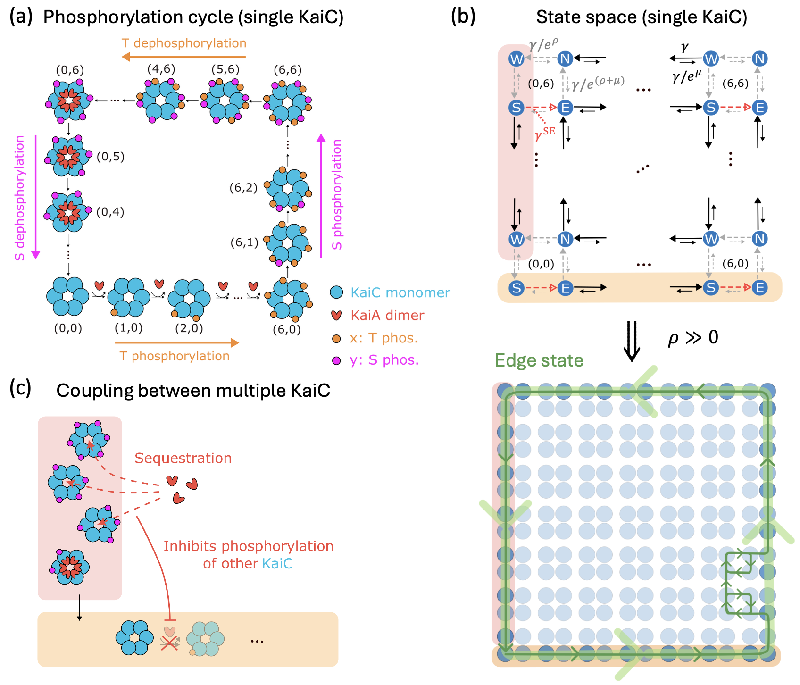
In the quest to understand the intricate dance of life, researchers have shed light on the synchronization of circadian rhythms, revealing how topologically protected oscillators can lead to a remarkable phase transition from chaos to order. A groundbreaking study by Chongbin Zheng, Peter Thomas, and Evelyn Tang explores the synchronization of circadian KaiC proteins, offering insights into how even inherently noisy systems can achieve coherent, rhythmic behaviors vital for survival.
The Challenge of Stochastic Oscillators
Many natural systems, including biological clocks, rely on oscillations to regulate timing processes. However, these oscillators often face the disruptive influence of intrinsic stochasticity, which can thwart their regular rhythms. Previous models have primarily focused on deterministic oscillators, failing to fully capture the complexity of stochastic systems. This research pioneers a new approach by focusing on the KaiC circadian clock, offering a theoretical framework that incorporates the stochastic nature of these molecular oscillators.
A New Phase Transition Mechanism
The study reveals a novel phase transition to synchronization that is contingent solely on a property called single-oscillator coherence - a measure of how reliably each oscillator operates. Remarkably, this coherence does not hinge on specific biochemical reaction rates but emerges as a robust feature across varying molecular environments. By integrating KaiA sequestration—a process where the Kai proteins regulate each other's phosphorylation—the researchers elucidate how individual oscillators can maintain synchronization amidst environmental fluctuations.
Insights from Experimental Observations
The findings of this study have profound implications, explaining several existing experimental observations related to circadian rhythms. For instance, the model predicts that modifications that enhance single-oscillator coherence—such as increasing ATP/ADP ratios—can compensate for disruptions caused by other factors like KaiB mutants. This adaptability suggests a pathway for biological systems to stabilize their rhythms even in the face of fluctuating conditions.
Practical Applications and Future Directions
Understanding these mechanisms could pave the way for advancements in synthetic biology, where designing reliable biochemical oscillators mirrors natural synchronization. This research not only enhances our grasp of circadian rhythm dynamics but also opens new avenues for studying stochastic behavior across various biological systems, from neuronal networks to metabolic pathways. The implications of this work extend beyond the laboratory, offering potential strategies for improving health routines and addressing challenges in biological timing.
Conclusion
By unraveling the complex interplay between stochastic elements and synchronization, this research underscores a fundamental principle: that harmony can emerge from chaos. As we delve deeper into the world of biological rhythms, the insights gained may well redefine our understanding of timekeeping within living systems.
Authors: Chongbin Zheng, Peter Thomas, Evelyn Tang




