
How Mudskippers Master Mud: Tail-Thrusting Techniques for Traversing Sticky Terrain
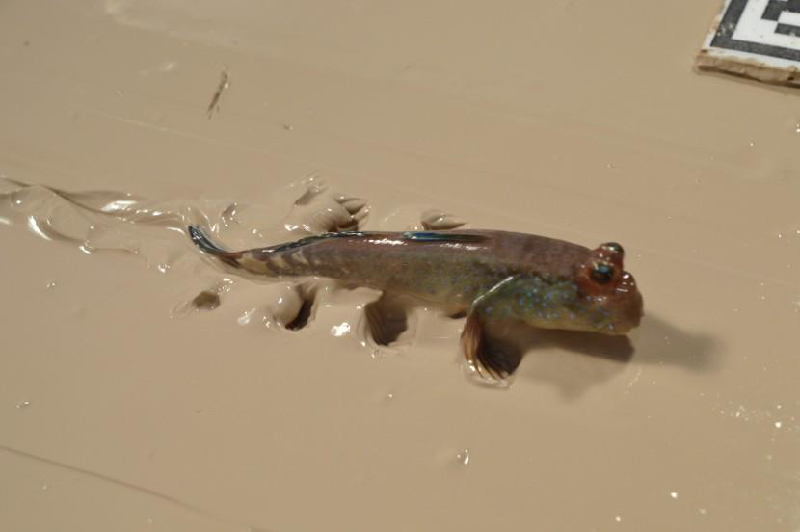
A fascinating study from researchers at Johns Hopkins University illuminates the remarkable adaptive strategies of mudskippers—unique amphibious fish known for their ability to thrive both in water and on land. This new research investigates how these fish utilize tail thrusting in conjunction with their signature "crutching" gait to navigate various types of muddy substrates.
The Challenge of Transitioning Terrain
Mudskippers inhabit environments where they frequently transition between wet mud and dry land. This poses significant locomotion challenges due to the variable properties of mud, which can range from solid to fluid-like states depending on its wetness. The study reveals that as mud becomes wetter, its ability to support weight decreases by a staggering factor of 100, leading the mudskipper to sink more deeply into the substrate, thus altering the dynamics of their movement.
Crutching and Tail Thrusting: A Dynamic Duo
Mudskippers primarily navigate muddy terrain using their large, robust pectoral fins in a motion referred to as crutching. This method, however, becomes less effective on the wettest mud. Consequently, these fish employ tail thrusting, which involves bending and straightening the tail to push against both the mud and their bodies, generating additional thrust for movement. This two-pronged approach allows mudskippers to maintain mobility even when mud conditions become dauntingly challenging.
Quantifying Mud Dynamics
The researchers meticulously controlled and varied the wetness of clay mud during experiments, discovering that the mechanical properties of mud significantly impact the efficiency of mudskipper locomotion. Measurements indicated that the force of the mud opposing movement changes not just with its moisture content but also due to the area of contact with the fish’s body. This highlights the intricate relationship between substrate properties and the ability of mudskippers to adapt their movement strategies accordingly.
Adaptive Behavior Under Changing Conditions
The findings of the study reveal a fascinating adaptability within the mudskipper's locomotion. On wet mud, rather than relying solely on their crutching technique, these fishes increasingly utilize their tails to assist movement, which is a critical adjustment when facing deep mud that offers less resistance. The research underscores that this flexibility is not only prominent in their swimming strategy but also points to a deeper evolutionary adaptation to their complex habitats.
Implications of the Research
Understanding how mudskippers navigate their muddy environments sheds light not only on the evolution of terrestrial locomotion among aquatic species but also on potential biomimetic applications in robotics. The insights gained from their locomotion techniques may inform the design of robots that operate on similar challenging substrates, emphasizing the practical relevance of mudskipper behavior in developing innovative technology.
This research opens new avenues for studying amphibious creatures and adapting their unique strategies to enhance the efficiency of both natural and engineered locomotion systems.
Authors: Divya Ramesh, Gargi Sadalgekar, Jiangqi Tan, Chen Li




