
Pioneering New Lower Bounds: How Gradient Descent Just Got a Serious Upgrade
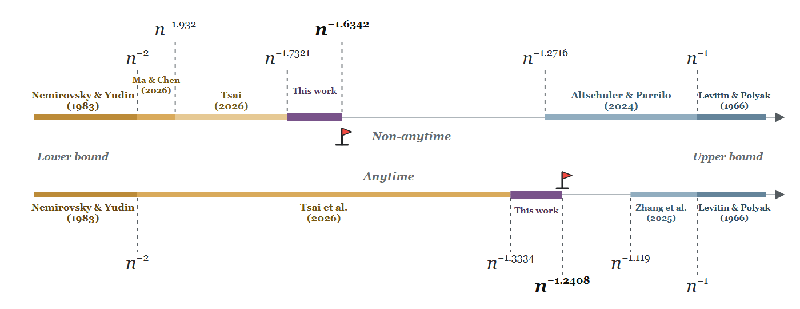
In recent research, MIT scholars Yuhan Ye and Kaizhao Liu have made significant strides in the realm of optimization by enhancing the understanding of gradient descent (GD), a foundational algorithm in machine learning and numerical optimization. The authors have established new lower bounds that elevate the performance expectations of GD when harnessed with predetermined step sizes, providing insights that could influence various optimization applications.
The Basic Premise of Gradient Descent
Gradient descent is a simple yet powerful algorithm used to minimize functions by iteratively moving towards the steepest descent, driven by the function's gradient. Classically, it has been constrained by the assumption that no predetermined adjustments to the step size would yield better results. Up until now, the best-known lower bound for first-order methods—including GD—was Ω(n−2), a result dating back to Nemirovsky and Yudin in 1983.
What's New? The Enhanced Lower Bounds
This groundbreaking paper introduces two improved lower bounds: an Ω(n−1.6342) non-anytime bound and an Ω(n−1.2408) anytime bound. The implications of these findings are substantial, as they surpass previous lower bounds of Ω(n−1.932) and Ω(n−4/3) seen in other studies. Essentially, what these new bounds indicate is that with carefully crafted predetermined step sizes, gradient descent could converge faster than previously thought, offering a more efficient path to finding optimal solutions.
Breaking Down the Complexity
The paper sheds light on how to achieve these new rates through a systematic approach that not only analyzes the mathematical foundations but also proposes innovative techniques in the function construction used for proving the bounds. This includes a refined sequence inequality and the use of a hard-function family that supports the demonstrated convergence rates. The approach is mathematical and complex, yet it echoes a pivotal shift towards optimizing GD further.
Potential Repercussions in Optimization Practices
The results of this research could profoundly impact numerous domains that rely on optimization techniques, including machine learning, operations research, and data analysis. As the growing field of AI continues to demand faster and more efficient algorithms, these enhanced bounds for gradient descent may facilitate quicker convergence in larger, more complex datasets, ultimately enhancing both performance and accuracy in real-world applications.
Conclusion: A Leap Towards Faster Optimization
Ye and Liu’s findings represent a noteworthy advancement in the understanding of gradient descent, challenging previously held beliefs about the limitations of the algorithm. As this research develops, we can expect to see more efficient methodologies emerge, paving the way for faster optimization processes that could redefine how we approach problem-solving in mathematics and computer science.
Authors: {Yuhan Ye, Kaizhao Liu}




