
PRISM: The Game-Changing Framework for Teaching Robots to Handle Everyday Objects
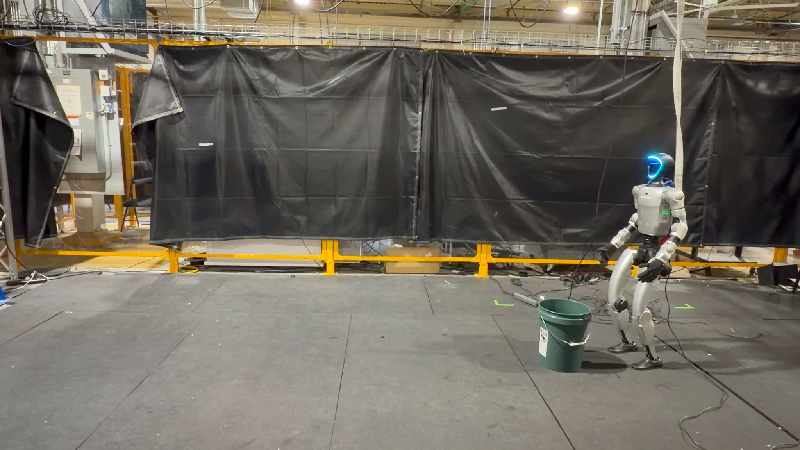
In the world of robotics, teaching humanoid robots to perform tasks such as picking, carrying, and dropping various objects has always been a daunting challenge. A recent groundbreaking research paper introduces a novel approach called PRISM, a real-to-sim-to-real framework that enables robots to learn from a surprisingly limited amount of real-world video footage.
Understanding PRISM: A New Approach to Object Interaction
PRISM stands for a framework that uses "counterfactual" video generation to expand a handful of real videos into a diverse set of training data. While traditional methods often struggle with acquiring the necessary video data for training, PRISM can take just a few real-life examples and generate hundreds of simulated videos. This is particularly exciting because robots can be trained to interact with a broader range of objects without needing extensive human demonstrations.
How It Works: The Three-Stage Process
The PRISM framework operates in three key stages:
- Video-to-Video Generation: From a select few real videos, PRISM generates multiple "counterfactual" videos that showcase human-robot interactions with various objects. For instance, a video of a human lifting a box can be transformed into videos where the object is a ball, bin, or barrel.
- Contact-Anchored Reconstruction: The system reconstructs the human motion and object interactions using contact points as anchors to ensure realistic and physically plausible movements.
- Policy Learning: Finally, a unified policy is trained using the reconstructed data, allowing the robot to perform zero-shot interactions with unseen objects in real-world environments without any additional fine-tuning.
Remarkable Results: Robots Learning Without Extensive Fine-Tuning
One of the standout findings from the research is that the robots trained with this method were able to pick up, carry, and drop unseen instances of various categories of objects successfully. For example, in practical tests, humanoid robots were able to interact with unfamiliar boxes, barrels, and balls, demonstrating their adeptness at generalizing from the learned behaviors without prior specific training on those objects.
The Innovation of Counterfactual Videos
What makes PRISM particularly innovative is its use of counterfactual videos—these depict interactions that never happened in the original videos but could theoretically occur with different objects. This flexibility allows robots to learn how to handle a variety of shapes, sizes, and weights, all from a limited set of initial demonstrations. It underlines a significant leap forward in utilizing generative models to train robots more effectively and efficiently.
Looking Ahead: The Future of Humanoid Robotics
As this research paves the way for more advanced humanoid robots, the implications extend beyond simple object manipulation. Interactive capabilities in various settings—from homes to workplaces—could potentially revolutionize industries that require automated assistance. Moreover, as researchers continue to refine and expand PRISM, the possibility of real-world applications becomes more attainable, opening doors to more sophisticated and autonomous robotic systems.
In summary, the PRISM framework demonstrates how leveraging creative video generation techniques can dramatically amplify the learning process for robots, enabling them to navigate and interact with the complexities of real-world objects with unprecedented ease.
Authors: Zihan Wang, Zhen Wu, Pieter Abbeel, Rocky Duan, Jitendra Malik, Carmelo Sferrazza, C. Karen Liu, Guanya Shi, Angjoo Kanazawa


