
Redefining Robotic Precision: How Facet-0 Masterfully Navigates Contact-Rich Assembly Tasks
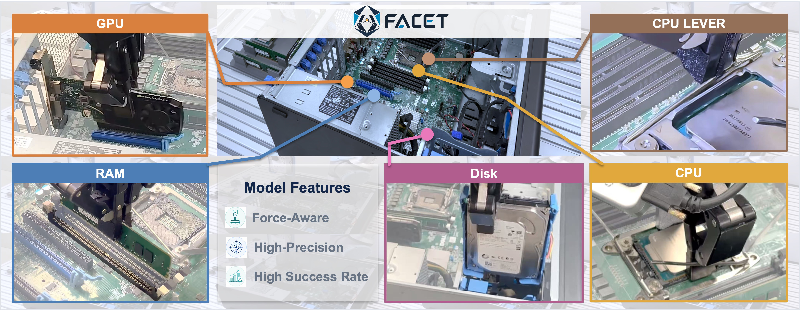
In a groundbreaking development in robotic technology, researchers at Nanyang Technological University have introduced Facet-0, a revolutionary robotic foundation model specifically designed for contact-rich precision manipulation tasks. This innovative system not only enhances the capability of robots to perform delicate assembly tasks with remarkable accuracy but also addresses some of the significant challenges associated with robotics in real-world scenarios.
The Challenge of Precision in Robotics
Robotic assembly often requires actions to be executed with sub-millimeter precision. Small errors in a robot's movements can lead to significant complications, including jamming or damage to delicate components. Hence, the ability to predict and adapt to the consequences of its movements is paramount for robots that operate in environments where every millimeter counts.
Introducing Facet-0: A New Frontier
Facet-0 stands out with its integration of multimodal representation learning and reinforcement learning (RL), which allows the robot to understand and value the different outcomes of its actions. This system innovatively aligns a history of wrench (force and torque) measurements with visual and language signals, making it possible for the robot to anticipate physical interactions before they occur. For example, Facet-0 can discern when a particular motion might lead to successful insertion versus when it might result in a jam, allowing for more deliberate decision-making in real-time.
Key Features of Facet-0
- Action-Wrench Proposal Mechanism: The model generates joint proposals for actions and predicted wrench effects, which not only directs the robot's movements but also incorporates expected contact dynamics into its decision-making process.
- Deployment Rollouts: Facet-0’s learning is enhanced through deployment experiences, effectively refining its behavior based on real-world interactions instead of just theoretical training.
- High Success Rates: In rigorous tests, Facet-0 achieved an impressive 82% success rate across multiple assembly tasks, a significant leap from the mere 15% rate of traditional methods, showcasing its effectiveness in real-world applications.
Implications for the Future
The introduction of Facet-0 is poised to set a new standard for robotics in various fields—particularly in manufacturing, healthcare, and any domain that relies on precision assembly. By merging semantic and physical understanding, Facet-0 not only enhances the efficiency of robotic systems but also paves the way for greater autonomy in machines.
As the technology matures, we can expect to see even more advanced applications, potentially leading to robots that can operate seamlessly in environments filled with people and complex tasks without extensive human supervision. Facet-0 represents a vital step toward smarter, safer, and more efficient robotic systems capable of performing intricate assembly tasks with utmost precision.
For those interested in exploring the depths of this innovative technology, more details can be found on the project page: Facet-0 Project.
Authors: Haoyuan Deng, Haichao Liu, Wenkai Guo, Yuan Ling, Zaijia Yang, Yuanjiang Xue, Haosheng Sun, Liangzi Wang, Ziwei Wang




