
Revolutionizing 3D Concrete Printing: The Game-Changer of Extruded Filament Geometry on Buildability
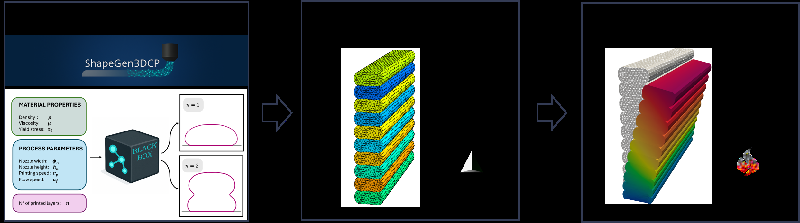
In the world of 3D concrete printing (3DCP), the shape of the extruded filament isn't just a minor detail – it can significantly impact the structural performance and stability of printed objects. A recent study conducted by researchers from Politecnico di Milano and Bundesanstalt für Materialforschung und -prüfung (BAM) introduces a groundbreaking approach that utilizes geometry-informed deep learning to predict filament shapes, thereby enhancing buildability assessment methods in 3DCP.
The Importance of Filament Geometry
While past finite element (FEM) models primarily simplified extruded filaments to basic rectangular shapes, this practice often compromised the predictive accuracy of buildability assessments. The latest research addresses this shortcoming by integrating a deep-learning tool, ShapeGen3DCP, which predicts the realistic geometries of extruded filaments based on material properties and printing parameters.
By doing so, the study reveals that the accurate representation of filament geometry is vital, particularly under free-flow deposition strategies where traditional rectangular models fail to capture essential characteristics, leading to less reliable predictions of print stability and performance.
A New Workflow for 3DCP
The proposed methodology merges the filament shape predictions with a layer-activation FEM framework, creating a streamlined workflow that enhances buildability assessments without the need for time-consuming experimental filament characterizations or complex fluid simulations. This workflow allows for the automatic generation of geometry-aware numerical models directly from input parameters.
Validation against experimental data confirmed the enhanced predictive capability of the new approach, highlighting the significant role played by filament geometry on buildability. The research also found that simpler geometric representations, such as elliptical approximations, provided a reliable balance between fidelity and computational efficiency.
Practical Guidelines for the Future
The insights gained from this research offer practical guidance for designers and engineers in the field of 3DCP. The study encourages the adoption of geometric shape analysis in buildability evaluations and provides a design chart to estimate uncertainties associated with different filament representations. This chart serves as a valuable tool for selecting the most appropriate geometric model depending on the desired accuracy and computational resources.
Ultimately, this innovative research not only enhances the reliability of buildability predictions but also sets the stage for more complex assessments in the future, potentially paving the way for advancements in automated and flexible construction techniques.
Authors: Giacomo Rizzieri, Saif-Ur-Rehman, Jörg F. Unger, Annika Robens-Radermacher




