
Revolutionizing Academic Advisor Discovery: A Deep Dive into Effective Retrieval Techniques
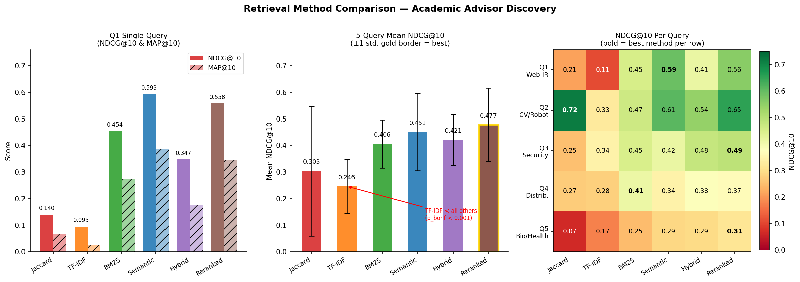
Identifying the right academic advisor can be a daunting task for graduate students, often requiring extensive manual browsing of faculty profiles across various universities. A new research paper by Biraj Subedi evaluates six innovative information retrieval methods aimed at simplifying this process. Conducted on a dataset of 768 computer science faculty profiles from nine US universities, this study provides valuable insights into the most effective ways to match students with potential advisors based on their research interests.
The Challenge of Advisor Discovery
Traditional advisor discovery in academia is rife with challenges. Students typically face issues such as vocabulary mismatches—when a student's research interests don't align with the keywords used by a professor. Additionally, the lack of a ranked comparison forces applicants to rely on memory, and the spread of information across disparate faculty pages complicates direct comparisons. These hurdles highlight the need for a more refined approach to advisor matching.
Methods Under Scrutiny
The research rigorously compares six retrieval methods, including both traditional keyword-based approaches like TF-IDF and BM25, as well as more modern semantic retrieval techniques utilizing embeddings. Remarkably, the study focuses on creating a unique evaluation collection specifically designed for this task, which is a crucial contribution given that no such benchmark previously existed.
Key Findings
Among the most surprising findings is that the method known as "Reranked," which combines multiple scoring techniques, emerges as the most effective overall, achieving an NDCG@10 score of 0.477. In sharp contrast, the TF-IDF method was significantly outperformed across the board, revealing it to be the least effective option for this particular application.
Another critical insight is the superior role of biographical information over structured research area tags. When biography alone was evaluated, it achieved an impressive NDCG of 0.634 compared to the full model which combined various fields, indicating that overloading with structured tags can actually detract from retrieval quality.
Implications for Future Approaches
The research paves the way for new strategies in building academic advisor discovery systems. Notably, the paper suggests that a 'late-fusion' architecture might be the optimal next step, which involves embedding profile information and research papers separately to avoid signal dilution.
Conclusion
Subedi's research challenges existing paradigms in academic advisor retrieval and opens the door for more sophisticated methods that leverage both traditional and modern techniques. As more data becomes available and retrieval methods advance, students may soon find it significantly easier to discover the ideal academic mentors for their research journeys.
For those interested, all code, scrapers, and relevance labels from this study are openly available, promoting transparency and reproducibility in academic research.




