
Revolutionizing Data Lakes: Meet DIADA, the Future of Automatic Data Composition!
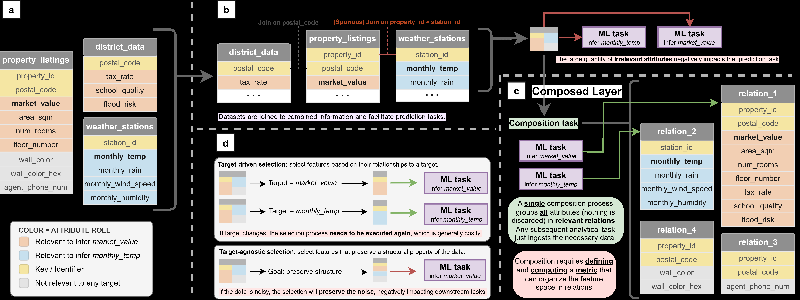
In the expansive world of data analytics, one of the greatest challenges is managing and extracting meaningful insights from the vast quantities of data present in data lakes. These repositories often become disorganized, leading to wasted time and resources. Enter DIADA, a groundbreaking system introduced by researchers from the Universitat Politècnica de Catalunya that automates the process of data composition, making sense of chaotic data lakes without being limited by specific analytical goals.
The Challenge of Data Composition
Data lakes are essential in modern data-driven organizations, offering a flexible storage solution for various datasets. However, they often become poorly structured, resembling data swamps where relevant information is buried under layers of irrelevant attributes. A conventional approach to data organization relies on manual efforts by domain experts or rudimentary features, like joinability, which often fail to guarantee meaningful connections between attributes. This leaves data practitioners grappling with irrelevant data, impacting the accuracy of analyses performed later.
What is DIADA?
DIADA stands for "Discovering Intrinsic Attribute Dependencies At scale." It is the first system capable of performing automatic data composition by exploring the relationships among various data attributes without focusing on any specific target attribute. This revolutionary framework uses statistical techniques to assess multivariate dependencies across a dataset, allowing data scientists to identify which attributes naturally belong together, thus enhancing the overall analytic value of the composed data.
How Does DIADA Work?
At its core, DIADA operates by hypothesizing that all attributes are independent and then employs statistical tests to identify those that exhibit dependencies. The researchers developed an innovative algorithm that efficiently mines a "predicate space," representing various attributes of the dataset. This approach allows DIADA to uncover statistical relationships that existing methods would miss, effectively transforming the landscape of data composition.
By utilizing what the researchers refer to as a "lattice under inclusion," DIADA identifies valuable attribute sets that display multivariate dependence—an essential characteristic for constructing meaningful relations in datasets. It goes beyond traditional methods, analyzing dependencies that could arise when multiple attributes interact rather than merely assessing pairwise associations.
Benefits of Using DIADA
One of the most significant advantages of DIADA is its scalability. The researchers demonstrated that their method can outperform classical algorithms in the context of large datasets, enabling the efficient detection of relationships that would otherwise be impractical to identify. Additionally, DIADA significantly reduces noise in the final datasets while preserving relevant attributes, leading to more accurate and insightful analyses.
Perhaps most importantly, the same composition process supports various analytical tasks. This means that after executing DIADA just once, data teams can confidently employ the resulting datasets for different down-the-line models and applications, enhancing both performance and robustness.
Conclusion
In summary, DIADA represents a significant leap forward in the way we compose and manage data within lakes. By automating the complex task of attribute organization and dependency analysis, it not only enhances efficiency in data preparation but also ensures that data scientists can focus on insights rather than data cleanup. As organizations continue to navigate the challenges posed by vast and unstructured data, systems like DIADA will prove invaluable in transforming analytics from a daunting task into a streamlined process.
For those interested in deepening their understanding of DIADA, the research team has made it accessible on their GitHub repository.
Authors: Marc Maynou, Albert Martin, Sergi Nadal, Anna Queralt, Oscar Romero


