
Revolutionizing DNA Synthesis: How Drt3b's Unique Mechanism Defies Traditional Templates
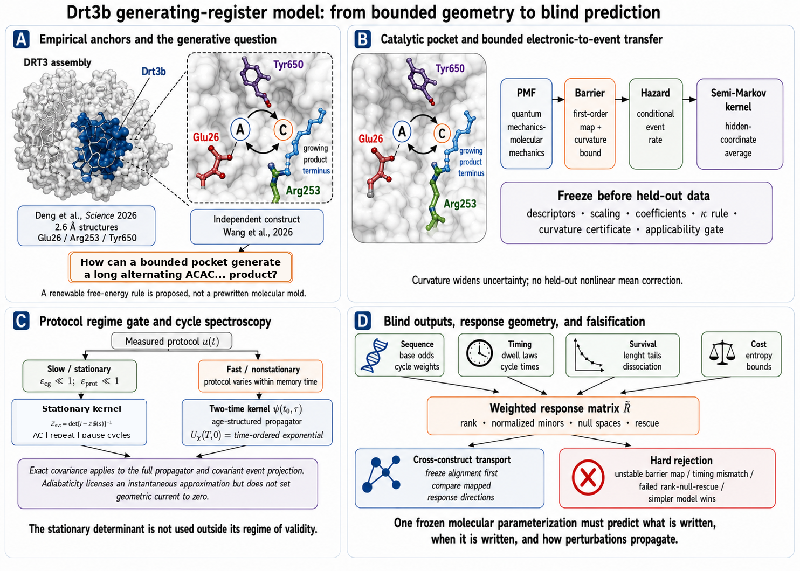
In a groundbreaking study led by Wei-Wei Zhang from Adventin Inc., researchers have uncovered the remarkable capabilities of Drt3b, a protein that synthesizes DNA without a nucleic-acid template. This innovative research presents a new framework for understanding DNA synthesis, which could have profound implications for biotechnology and synthetic biology.
The Unconventional Path of Drt3b
Traditionally, DNA synthesis has relied on the presence of nucleic acids as templates. However, Drt3b operates differently by utilizing a unique mechanism that allows it to produce the complementary poly(AC) strand independently. This protein-primed process was highlighted by Deng et al. in a recent publication, which provided critical structural insights into how Drt3b operates.
A New Framework for Understanding Protein Dynamics
The study introduces a "regenerating protein-substrate free-energy register" that fundamentally alters how we view nucleic acid synthesis processes. This framework integrates quantum and molecular mechanical principles to predict factors such as sequence timing and perturbation responses. Unlike conventional models, this approach emphasizes a more integrated relationship between the protein's structure and its functional capabilities.
Significant Insights and Predictions
One of the key findings of this research is the ability of Drt3b to predict nucleotide choices and the timing of synthesis events based on its inherent structural dynamics. By examining the conditional hazards associated with different nucleotide sequences, the research demonstrates that the selection process is not random, but rather a function of predefined physical parameters encoded in the protein's architecture.
Implications for Future Research
This research not only deepens our understanding of protein dynamics in DNA synthesis but also opens up new avenues for synthetic biology. The ability to manipulate and design proteins that can synthesize DNA in novel ways could pave the path for advancements in gene editing, therapeutic development, and the creation of synthetic life forms.
As Dr. Zhang notes, "These findings challenge conventional wisdom and suggest that we may be just scratching the surface of what is possible in biological synthesis." With further research, the full potential of Drt3b and similar proteins could be unlocked, dramatically impacting both the scientific community and industry applications.
This study sets a new benchmark in the field of biophysics and synthetic biology, highlighting the potential for innovative, template-independent mechanisms in genetic engineering.
For more information, contact Dr. Wei-Wei Zhang at wzhang@adventin.com.




