Revolutionizing Educational Diagnostics: ParLD Unveils Insightful Conversational Learning Tools
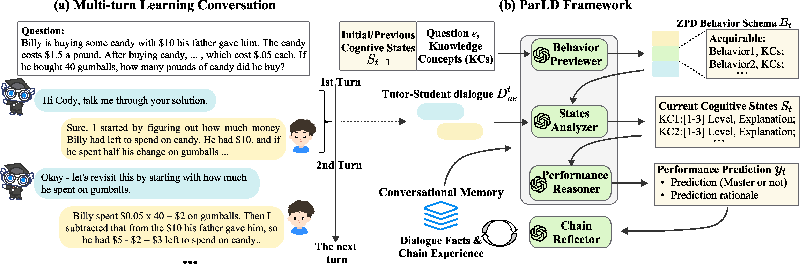
In the ever-evolving landscape of educational technology, a groundbreaking research study sheds light on an innovative method for diagnosing student learning in real-time. The paper, authored by Fangzhou Yao and colleagues from the University of Science and Technology of China, introduces a novel framework named ParLD, which leverages multi-agent collaboration to enhance the understanding of students' cognitive states during interactive dialogues.
The Need for Accurate Learning Diagnosis
Traditional educational methods often fall short in accurately assessing a student's understanding, especially during conversational learning scenarios. As students engage in dialogues with tutors—whether human or AI—the complexity of natural language and the subtleties of learner responses can elude conventional diagnostic approaches. Current techniques tend to analyze isolated responses rather than the evolving nature of dialogue, which limits their effectiveness.
Introducing ParLD: A Game Changer in Learning Diagnosis
The ParLD framework takes a fresh approach to learning diagnosis by incorporating a Preview-Analyze-Reason cycle. This structure allows for a continuous assessment of a student's cognitive development throughout multiple dialogue turns. At its core, ParLD consists of four primary components:
- Behavior Previewer: Generates a behavior schema based on students’ prior responses and the learning objective.
- State Analyzer: Examines the current dialogue to update the student's cognitive state.
- Performance Reasoner: Predicts future student responses and allows for reflective feedback.
- Chain Reflector: Reviews the entire interaction to improve future diagnostics systematically.
Breaking Down the Components
Understanding each component of ParLD is key to appreciating its impact. The Behavior Previewer uses educational theories, such as the Zone of Proximal Development (ZPD), to anticipate student behaviors in learning contexts. This insight enables the system to tailor its responses far more effectively than traditional methods.
The State Analyzer then takes real-time inputs from student-tutor dialogues and compares them to the anticipated behaviors outlined in the behavior schema. This comparison facilitates a nuanced understanding of the student’s progression.
What's more, the Performance Reasoner offers predictive insights based on the updated cognitive state, making it easier for tutors to provide precise support based on individual learner needs. Meanwhile, the Chain Reflector engages in a self-corrective process that revisits previous assessments and continuously improves the accuracy of cognitive diagnosis.
Validation Through Experiments
To ensure the robustness of ParLD, the authors conducted various experiments, demonstrating its superiority over existing models in predicting student performance during learning sessions. Notably, the framework achieved impressive accuracy rates with datasets like MathDial and CoMTA, standing out in the educational landscape for its ability to generate meaningful assessments and enhance tutoring support.
Implications for the Future of Learning
The implications of this research extend far beyond mere diagnostics. By providing a reliable tool for understanding student cognition through conversational learning, ParLD positions itself as a vital asset in educational environments. With its innovative capabilities, the framework promises to enhance personalized learning experiences, allowing for tailored tutoring that better aligns with each student’s unique learning trajectory.
In conclusion, the introduction of ParLD marks a significant leap forward in educational diagnostics. By effectively bridging the gap between conversational exchanges and cognitive assessment, this framework has the potential to revolutionize how tutors support learners, ultimately leading to improved educational outcomes.

