
Revolutionizing Environmental Monitoring: A New Adaptive Framework for Wireless Sensor Networks
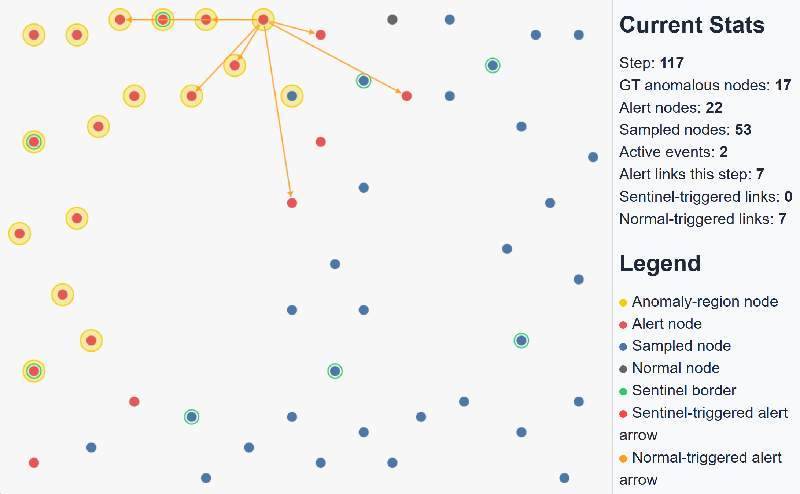
In a groundbreaking study from researchers at South East Technological University, a new approach to anomaly monitoring within wireless sensor networks (WSNs) has emerged. This research tackles the challenge of balancing energy efficiency with timely event detection, which has significant implications for long-term environmental monitoring, smart agriculture, and more.
The Challenge of Anomaly Detection
Traditional methods of monitoring using WSNs often rely on sparse sampling to conserve energy. However, this technique can miss critical, short-lived anomalies that may arise in the environment, such as sudden temperature spikes or drops. In their paper, the authors propose a novel adaptive sampling framework that intelligently utilizes a combination of sparse and continuous sampling strategies to enhance anomaly detection.
How the Framework Works
The proposed sentinel-assisted adaptive sampling framework operates in two distinct modes. During normal conditions, sensor nodes utilize a Kalman filter to manage predictive uncertainty and to sample data sparsely. When an anomaly is detected, specific "sentinel" nodes transition to continuous sampling mode to identify the anomaly and trigger a localized response within neighboring nodes.
This innovative system doesn't just increase sampling rates indiscriminately; it efficiently reallocates resources towards regions experiencing anomalies, thereby maintaining energy savings while improving detection rates.
Key Findings and Results
Experiments conducted using data from the Intel Berkeley Research Lab have shown impressive results. The framework increased the Anomaly-Window Sampling Ratio (AWSR) from 0.439 to 0.933 compared to previous methodologies, significantly enhancing event coverage while also decreasing overall energy costs by an average of 15%. This efficiency is vital for the practical deployment of WSNs in real-world applications.
Not only does this framework ensure better detection of environmental changes, but it also provides a robust solution to the energy-accuracy trade-off that has plagued traditional monitoring systems.
Future Implications
The implications of this research are far-reaching. As the world becomes increasingly reliant on technology to monitor crucial environmental data, implementing such adaptive frameworks can lead to more sustainable practices in numerous fields. From monitoring climate change to maintaining agricultural health, this enhanced ability to detect anomalies can drive smarter decision-making and resource management in various sectors.
In conclusion, the sentinel-assisted adaptive sampling framework represents a paradigm shift in how we approach environmental monitoring. By merging energy efficiency with effective anomaly detection, this innovative solution paves the way for future advancements in wireless sensor networks.
Authors: Guoqing Lu, Yixuan Sun, Yiwen Jiang, Bernard Butler




