
Revolutionizing Financial Stability Analysis: A New Approach to Uniform Inference at the Reflexive Stability Boundary
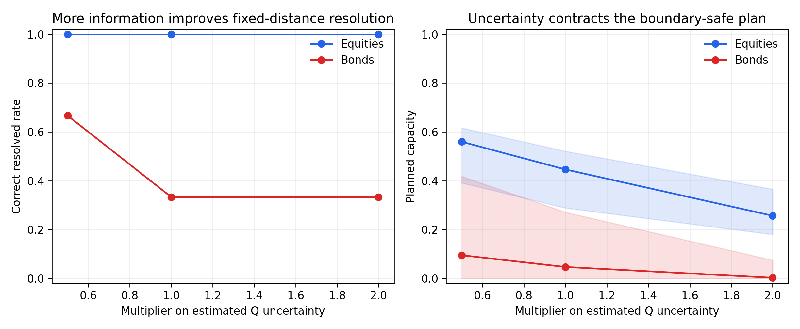
In a groundbreaking new paper, Alejandro Rodríguez Domínguez introduces an innovative framework for understanding financial stability that combines uniform inference and certified capacity decisions. The paper titled "Uniform Inference and Certified Capacity at a Reflexive Stability Boundary" sheds light on the complexities of financial systems and offers a robust solution to estimating critical stability boundaries.
The Challenge of Estimating Financial Stability
Financial markets are inherently unpredictable. One of the significant challenges in finance is estimating the stability boundary where market behaviors can shift drastically. Traditional methods often falter in these complex environments, especially around what is termed 'semisimple' or 'defective' collisions—situations where different market influences can lead to misleading interpretations due to sampling errors. Domínguez's work tackles this issue head-on by employing a joint confidence region approach designed to enhance inference capabilities across various market conditions.
A Unified Approach to Decision-Making
The crux of Domínguez's research lies in its ability to generate a three-way regime decision: subcritical, supercritical, or unresolved. This approach allows for more nuanced financial decisions, enabling analysts and policymakers to make informed choices about risk management and investment strategies under uncertainty. The research emphasizes that understanding the conditional risks, such as temporary cross-impact and effective risk-bearing capacity, from dependent observations is crucial for accurate boundary estimation.
Key Insights and Methodologies
Utilizing a unique methodology, the study incorporates empirical simulations that reveal the trade-off between coverage and resolution in statistical assessment. This innovative approach not only provides robust accuracy but also guards against misleading conclusions that could arise from incomplete data analysis. By focusing on projected joint confidence regions, the research offers a pathway to precisely assess market stability over time, with significant implications for investment strategies and regulatory frameworks.
Practical Applications for Financial Analysts
This research is particularly vital for financial analysts and investors, as it equips them with a tool to navigate the uncertainties of financial markets. The implications of Domínguez’s work extend beyond theoretical finance; the findings can guide real-world decisions about capital allocations, risk assessments, and portfolio management. As markets evolve, having a reliable framework for understanding stability can lead to better outcomes and informed strategic planning.
In conclusion, Rodriguez Domínguez’s paper represents a significant step forward in financial modeling and risk management. By bridging the gap between complex market dynamics and statistical inference, this research not only aids in understanding the current state of financial systems but also helps prepare for future challenges. As the financial landscape continues to change, methodologies like this will be essential in maintaining stability and ensuring informed decision-making.
Authors: {Alejandro Rodríguez Domínguez}




