
Revolutionizing GPU Reliability: From Predicting Failures to Prioritizing Risks!
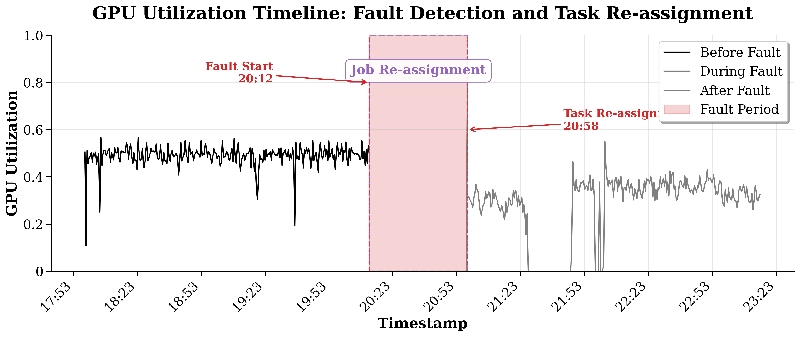
Recent research highlights a groundbreaking shift in how we approach the reliability of Graphics Processing Units (GPUs) within large-scale AI infrastructures. Traditionally, the emphasis has been on accurately predicting the moment these GPUs might fail. However, a new study emphasizes that rather than trying to pinpoint exact failures, the focus should be on identifying and prioritizing which GPUs are at higher risk of failure.
The Challenge with Predicting Failures
The study, titled "Don’t Predict, Prioritize: Rethinking GPU Reliability Assessment," by Difeng Ma and colleagues, uncovers significant challenges in correctly predicting GPU failures. Using telemetry data from a production cluster, researchers found that traditional methods, which rely on historical indicators like temperature and usage patterns, often resulted in unreliable predictions. Major failures displayed a chaotic nature, leading to what the authors termed "strong stochasticity" that muddied the signals needed for accurate forecasting.
A New Approach: HeaRank
In response to these challenges, the authors propose a new framework named HeaRank. Instead of forecasting specific failure moments, HeaRank ranks GPUs based on their relative risk of failure using stable historical failure patterns. By leveraging data on past incidents, the model successfully identifies the most vulnerable GPUs, achieving a remarkable 83.4% Area Under the Curve (AUC) in risk discrimination. In practical applications, HeaRank managed to successfully identify 64% of failures within the top 5% of ranked machines, substantially outperforming existing systems.
The Superiority of Risk Ranking
This innovative approach shifts the paradigm from challenging and often ineffective prediction to proactive risk management. By focusing on maintaining a list of high-risk GPUs, resources can be more effectively allocated, and potential disruptions minimized. Operational teams can prioritize their maintenance efforts, ensuring that critical tasks are assigned to stable GPUs, thereby improving the overall efficiency and reliability of AI model training environments.
Significance for the Future
This research underscores a crucial evolution in GPU reliability assessment methodologies, paving the way for safer, more efficient AI infrastructures. As AI continues to expand, understanding that not all GPUs are created equal, and some are more prone to fail than others, can lead to significant improvements in performance and resource management. With frameworks like HeaRank, the industry can move toward a more sustainable and resilient operational model.
As GPU technologies evolve, future research may refine such risk ranking models, potentially integrating a wider array of monitoring metrics to adapt to ever-changing operational environments. The core insight remains clear—prioritizing can be more effective than predicting, leading to a paradigm shift in how we handle hardware reliability in the fast-paced world of AI.
Authors: Difeng Ma, Changhua Pei, Yuanwei Lu, Quan Zhou, Zexin Wang, Yibo Zhu, Daxin Jiang, Dan Pei, Jingjing Li, Gaogang Xie




