
Revolutionizing House Hunting: How LLMs are Transforming Real Estate Search
In an era where technology dictates user preferences and experiences, it’s crucial for industries to adapt. The real estate sector is no exception. A groundbreaking research paper titled fLLM-Based Re-Ranking for Real Estate Search reveals how QuintoAndar, a leading housing marketplace in Latin America, is employing Large Language Models (LLMs) to elevate the real estate search experience. This innovative approach addresses the complexities of user intent in house-hunting by re-ranking potential properties through conversational context.
The Shift to Conversational Search
As users become accustomed to interacting with digital platforms via natural language, their expectations have transformed. They now prefer expressing their needs through free-flowing dialogue rather than rigid dropdown menus. Understanding this shift, QuintoAndar has introduced Concierge, a multi-agent assistant aimed at simplifying the home search process through natural language interactions.
However, finding the perfect match within vast property databases is inherently challenging. Traditional search methods often miss critical aspects of user intent. The research suggests that LLM-based approaches can appreciate the nuanced context provided by users' dialogues, which conventional systems tend to overlook.
Introducing the LLM-Based Re-Ranker
The heart of QuintoAndar's innovation lies in its LLM-based re-ranker, a system designed not just to retrieve, but to reorder property listings according to a user's specific desires articulated during conversations. The research details the development of a large-scale dataset comprising 960,000 query-item pairs that allowing the system to refine its understanding of user intent continuously.
This re-ranker has demonstrated its effectiveness in both offline and online evaluations, showing significant improvements in user engagement metrics. For instance, the enhanced model produced a 5.3% increase in click-through rates and a 4.8% boost in scheduled visits, underscoring the value of personalized recommendations based on conversational context.
How It Works: Methodology in Simple Terms
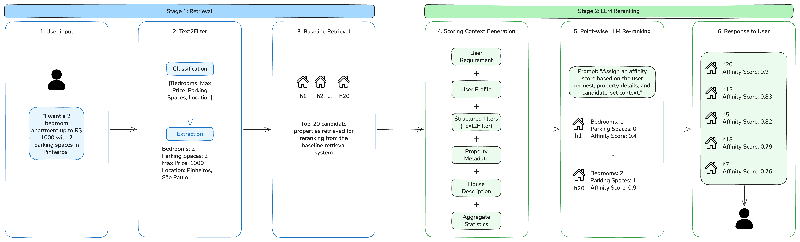
The researchers built a two-stage framework comprising a retrieval process that generates a candidate set of properties and a re-ranking stage that assesses these candidates using an LLM. The scoring process incorporates various inputs: the user’s natural language query, their previously expressed preferences, and statistical data about the candidate properties.
This sophisticated integration allows the LLM to assign affinity scores to properties, evaluating how well each option aligns with a user’s desires, whether explicitly mentioned or implied through previous interactions.
The Test Results: Confirming the Value of Personalization
To validate their approach, the researchers conducted an extensive A/B test involving over 200,000 real user interactions. The results were compelling: users interacting with the LLM-optimized system were more engaged, demonstrating a need for intelligence that genuinely understands context and personal preferences.
The findings indicate that by leveraging LLM technology, real estate platforms can significantly enhance their operational efficiency and better fulfill user needs, making the daunting task of finding a home far simpler.
Future Prospects in Real Estate Technology
The implications of this research extend beyond QuintoAndar. With ongoing advancements in conversational AI, we can expect a broader application of such technologies across various sectors to meet user demands for more human-like interactions and personalized experiences.
As users continue to embrace conversational interfaces, the integration of LLMs could further revolutionize how we find homes, making real estate search accessible, efficient, and remarkably user-friendly.
For anyone involved in digital transformation within the real estate sector, the insights drawn from this research open new pathways for innovation and user satisfaction.
Authors
This pivotal research was conducted by Nkateko Ntimane, Rafael Guedes, Tiago Cunha, and Pedro Nogueira, all affiliated with QuintoAndar and Growthloop. Their work emphasizes the intersection of AI and user-centered design in reshaping real estate experiences.




