
Revolutionizing Image Retrieval: The Game-Changing AutoConcept Framework
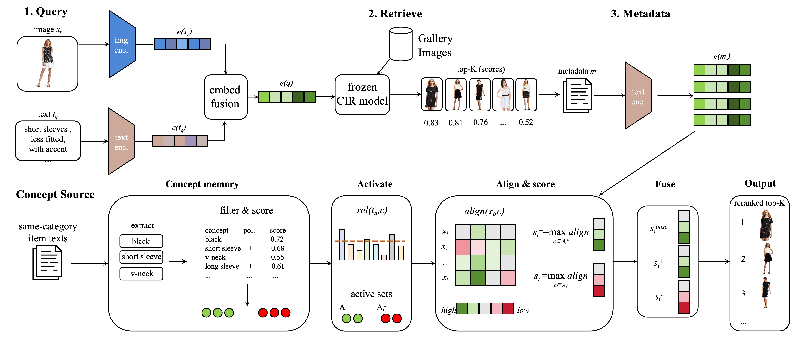
In a groundbreaking study, researchers have introduced AutoConcept, a revolutionary approach that enhances the performance of composed image retrieval (CIR) systems without the need for extensive training. The research, conducted by Tianyu Wang of Soochow University and Tianjiao Wu from INSTITUT NATIONAL DES SCIENCES APPLIQUEES DE LYON, presents a novel way to leverage metadata to refine image retrieval processes.
What is Composed Image Retrieval?
Composed Image Retrieval (CIR) allows users to find images using a combination of a reference image and a natural-language modification. This approach is particularly useful in e-commerce, where users may search for specific clothing items by describing desired features, such as color or style. Traditional CIR systems often rely heavily on training and may struggle with varying metadata and contextual language.
The Innovative AutoConcept Approach
AutoConcept builds upon the existing CIR framework by introducing a training-free reranking mechanism that incorporates metadata. This method operates on a fixed set of candidate images generated by a base retrieval model. The innovation lies in AutoConcept's ability to construct an interpretable concept memory from user queries, allowing for enhanced scoring of candidate images based on their relevance to specific user-defined concepts.
By converting concept evidence into a manageable memory, AutoConcept can actively filter out irrelevant concepts and focus on those that align closely with user queries. This system effectively uses a second-stage reranking process, improving the accuracy of searches significantly compared to existing models.
Key Findings and Results
In their experiments using the FashionIQ dataset, Wang and Wu demonstrated that AutoConcept enhances recall rates significantly—improving the retrieval system's early-rank accuracy from traditional methods, like WeiMoCIR, to new heights. For instance, the recall at top 10 results improved from 0.1125 to 0.1379. This improvement showcases how AutoConcept not only refines the image selection process but also allows for better interpretability and control over the ranking outcomes.
Human-Provided Indicators: A Vital Component
Another fascinating aspect of this study is the human concept-labeling experiment, where participants labeled various items, providing a source of concept evidence that AutoConcept could consume. The results indicated that even with varying quality and quantity of user-provided evidence, AutoConcept maintained its effectiveness, proving its robustness in real-world applications.
Conclusion: A Leap in Image Retrieval Technology
The introduction of AutoConcept marks a significant advance in the field of image retrieval technologies. By enhancing the usability of metadata and improving the reranking processes without extensive retraining, this method sets a valuable precedent for future developments in search engines and e-commerce platforms. As researchers continue to refine this technology, AutoConcept could become vital in improving user experiences across various visual search applications.
Through this innovative approach, the research opens up new possibilities for controlling and interpreting image retrieval systems, providing a structured and intuitive way for users to connect with the images they seek.
Authors: Tianyu Wang, Tianjiao Wu




