
Revolutionizing Information Retrieval: RICE Transforms Large Language Models with In-Context Examples
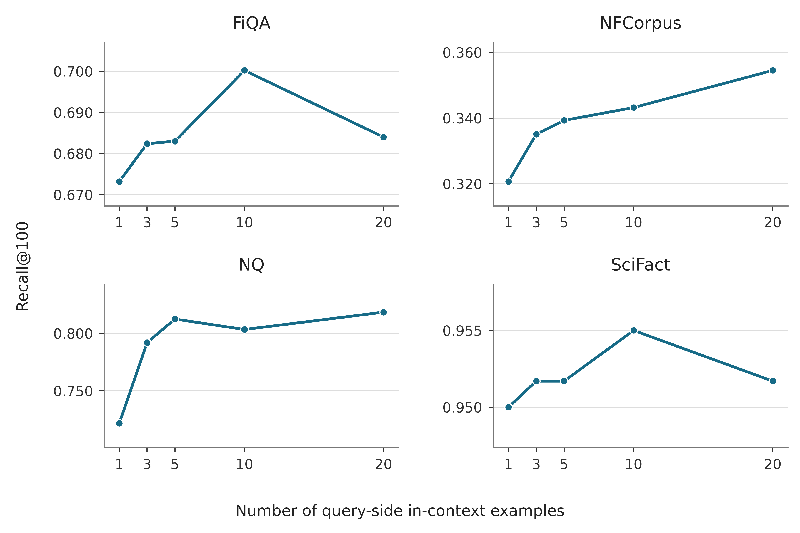
In a groundbreaking study conducted by Nour Jedidi, Abdul Basit Ali, Hang Li, and Jimmy Lin, researchers present a novel approach that challenges the conventional methods used for information retrieval using large language models (LLMs). The research paper, titled "Effective Dense Retrieval using Only In-Context Examples," introduces a method named RICE (Representations from In-Context Examples), which enables LLMs to produce meaningful representations for dense retrieval tasks without the usual extensive training.
The Problem with Traditional Training Methods
Traditionally, leveraging LLMs for effective information retrieval involves hefty training processes. These methods typically require extensive labeled data, supervised or unsupervised objectives to fine-tune models, and can be computationally expensive and complex. This conventional approach often restricts LLMs' usability in real-time applications where seamless retrieval is crucial.
Introducing RICE: A Training-Free Alternative
RICE is designed to address these challenges by utilizing only a handful of labeled in-context examples. Instead of undergoing additional training, RICE conditions the LLM on examples that provide a shared context, which enhances its ability to encode queries and documents more effectively. By prompting the LLM with examples that illustrate how it might represent a document relevant to a query, RICE can generate high-quality dense representations, facilitating accurate information retrieval.
How RICE Works
The core innovation of RICE lies in its simplicity. By employing just a few examples of query-document pairs, RICE significantly improves the LLM's understanding of relevance. The method operates by priming the model through these contextually relevant examples, allowing it to generate representations that directly reflect the underlying semantic relationships in the data.
The researchers demonstrated through various retrieval tasks that this approach not only enhances retrieval accuracy but also competes effectively against existing “training-free” dense retrieval methods. RICE notably outperformed traditional methods that rely on separate training, establishing a higher accuracy in retrieving relevant documents based solely on prompts.
Promising Results and Future Implications
RICE showed significant improvements across several benchmark datasets, confirming that high-quality embeddings can be derived from LLMs with minimal initial training. This is an exciting development for fields that utilize information retrieval, such as search engines, question-answering systems, and more, suggesting that LLMs could be deployed more effectively across varying domains without the cumbersome pre-training phase.
The release of RICE's code enables other researchers and developers to experiment with this method, potentially setting a new standard in the retrieval practices of LLMs. As models continue to evolve, finding ways to minimize training requirements while maximizing performance represents a crucial step toward more accessible artificial intelligence technologies.
Conclusion: A New Path Forward
In conclusion, the work by Jedidi et al. illuminates a future where LLMs can seamlessly adapt to new tasks and environments without the need for extensive training. The RICE method not only represents a significant advancement in dense retrieval but also opens new avenues for practical applications of LLMs in real-world scenarios.
For those interested in exploring this innovative approach, the code for RICE is available at the provided link, paving the way for enhanced information retrieval strategies that leverage the full potential of large language models.
Authors: Nour Jedidi, Abdul Basit Ali, Hang Li, Jimmy Lin.


