
Revolutionizing Multi-Agent Path Finding: Introducing MAGIC for Uncertain Environments!
In an era where the coordination of robotic agents is becoming increasingly vital across various industries, a new study sheds light on the groundbreaking model known as Belief-Aware Multi-Agent Path Finding (MAPF). This innovative approach tackles the challenge of navigating multiple agents through environments where obstacles are not only dynamic but also uncertain, enhancing efficiency and safety in real-world applications.
Understanding the Challenge of Path Finding
Multi-Agent Path Finding is a complex problem where several agents must find their way from designated start points to goals without colliding with one another or with stationary obstacles. Traditional models typically assume a fixed environment where all obstacles are known in advance. However, this assumption often falls short in real-life scenarios where physical conditions can change unexpectedly, such as blocked aisles in warehouses or obstructive objects in shared spaces.
Innovative Approach: Belief-Aware MAPF
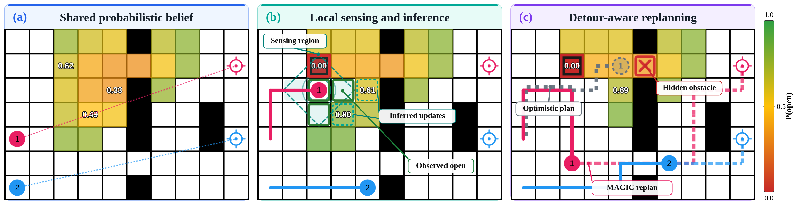
The researchers introduce a significant advancement with the Belief-Aware MAPF framework, which operates under the premise that some details about the environment’s navigability remain unknown during execution. Their solution, termed Multi-Agent Gaussian Belief Inference for Coordination (MAGIC), innovatively updates a shared belief about traversability based on observations made by the agents as they navigate.
At its core, MAGIC employs a Gaussian Markov Random Field (GMRF) to capture spatial dependencies among uncertain locations, providing agents with a probabilistic understanding of their environment. By processing this information, the model allows agents to foresee potential obstacles in nearby unobserved locations, enabling more informed decision-making during navigation.
A Game Changer in Efficiency
In various experiments across standard MAPF benchmarks involving up to 800 agents, MAGIC demonstrated impressive results, outperforming existing methods in 96.3% of instances. The framework significantly reduced the executed sum of costs compared to traditional methods, highlighting its potential for large-scale applications and emphasizing its robustness against environmental uncertainty.
Real-World Applications and Future Prospects
The implications of this research extend beyond theory. By effectively managing uncertain environments, MAGIC could revolutionize automated operations in warehouses, manufacturing, and service robotics, where efficiency directly correlates to productivity and safety. Future research aims to refine Belief-Aware MAPF further, potentially adapting it to dynamic settings where traversability constantly changes over time.
As industries embrace more autonomous solutions, the development of such resilient systems showcases the path toward a future where robots can better understand and navigate the complexities of their operational environments.
With advancements like MAGIC, we move closer to realizing fully autonomous multi-agent systems capable of efficiently managing the challenges of everyday environments.
Authors: Viraj Parimi, Shao-Hung Chan, Han Zhang, Jingkai Chen, Brian Williams


