
Revolutionizing Multi-Robot Collaboration: How DuoMind Enhances Coordination with Semantic Communication
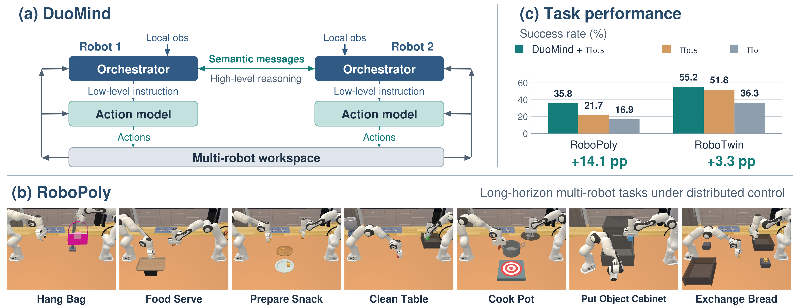
In a groundbreaking study, researchers at the University of California, Davis, alongside collaborators from Microsoft Research and Analog Devices, have revealed a new framework called DuoMind that promises to transform the way robots work together. This innovative system utilizes advanced Vision–Language Models (VLMs) and Vision–Language–Action models (VLAs) for distributed multi-robot coordination, making them capable of executing complex tasks as a team, rather than relying solely on individual robots operating in isolation.
The Challenge of Multi-Robot Settings
As robotics technology evolves, the focus has largely remained on single-robot systems. This research addresses a crucial gap: how to extend these capabilities to multi-robot systems, which are often essential for completing intricate tasks. Effective teamwork among robots presents substantial challenges, particularly when it comes to coordinating behaviors over long periods while ensuring precision and reliability in execution.
Introducing DuoMind: A Hierarchical Framework
DuoMind introduces a sophisticated hierarchical framework design aimed specifically at enhancing multi-robot coordination. Each robot operates under a dual system comprising a VLA for low-level action execution and a VLM for high-level task reasoning and coordination. This allows each robot to not only interpret instructions but also communicate its intentions and observations to fellow robots, effectively synchronizing their actions in real-time.
Semantic Communication: The Key to Coordination
The standout feature of DuoMind is its method of enabling robots to communicate semantically. By generating structured, natural-language messages, each robot can share critical information about its intentions, subgoals, and observations with other robots. This inter-agent dialogue is essential in scenarios where robots have a limited perspective on the environment and are unsure of each other's current actions.
RoboPoly: A Benchmark for Multi-Robot Tasks
To evaluate the capabilities of DuoMind, the researchers developed RoboPoly, a benchmark consisting of long-horizon manipulation tasks requiring explicit cooperation between robots. Tasks such as serving food and cleaning a table showcase the necessity of collaborative action—tasks that a single robot cannot accomplish efficiently alone. RoboPoly is tailored to challenge traditional single-agent benchmarks by focusing on multi-agent interactions under distributed control.
Results and Implications
Initial tests on RoboPoly and another benchmark, RoboTwin, have demonstrated that DuoMind significantly improves coordination and task execution rates compared to traditional methods. The findings indicate that the combination of high-level reasoning and inter-agent communication not only enhances performance but also minimizes the likelihood of conflicts during execution.
Looking Forward: A New Era in Robotics
The DuoMind framework exemplifies a pivotal advancement in the field of robotics. As robots become increasingly integrated into our daily lives and industries, enhancing their collaborative abilities will be essential. This research lays the groundwork for future developments, where multiple robots can work together in various environments—from homes to factories—effectively and efficiently. The implications for industries such as logistics, manufacturing, and even household chores are immense, as DuoMind sets the stage for smarter, more adaptable robotic systems that can truly function as teams.
As these technologies continue to evolve, the integration of strong reasoning capabilities with nuanced communication among robots is not just a scientific exploration; it opens up new avenues for practical applications, ensuring that we are one step closer to realizing the potential of fully autonomous robotic systems.
Authors: Hanchu Zhou, Dechen Gao, Hang Wang, Brendan Lynch, Boqi Zhao, Qiyao Ma, Raman Goyal, Junshan Zhang


