
Revolutionizing Neural Architecture Design: The Game-Changing MFSPNet Framework
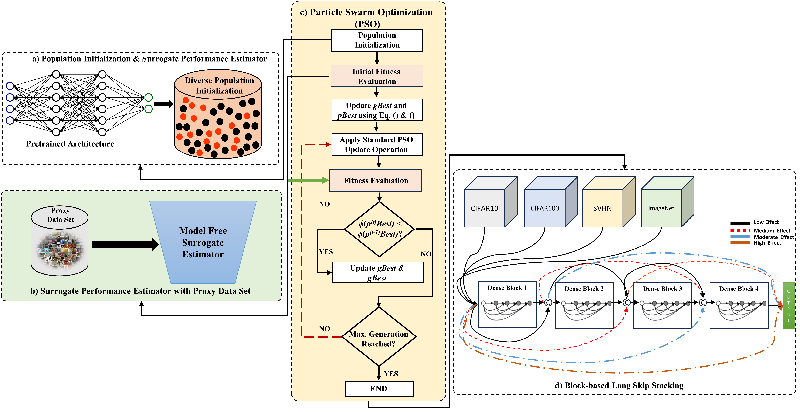
As the world of artificial intelligence continues to evolve, researchers are on a relentless quest to develop more efficient deep learning models. A groundbreaking paper titled Model-Free Surrogate-Assisted Neural Architecture Search for Evolving Variable-Length Dense Blocks, authored by Asif Ameer, Maryam Bashir, Irfan Younas, and Muhammad Fayyaz, explores a new frontier in neural architecture optimization, revealing a paradigm shift in how convolutional neural networks (CNNs) are designed.
What is MFSPNet?
MFSPNet, or Model-Free Surrogate PSO Network, represents a significant advancement in the process of neural architecture search (NAS). Traditional methods often rely on extensive computational resources to evaluate and refine architectures, making them prohibitively expensive for many practitioners. However, MFSPNet proposes a model-free surrogate performance predictor that enhances efficiency while maintaining performance - all without the need for pre-trained models.
Key Innovations
One of the paper's pivotal contributions is the integration of a lightweight model-free surrogate predictor within a particle swarm optimization (PSO) framework. This approach allows for the intuitive evolution of dense blocks tailored for image classification tasks. By using validation loss dynamics as a fitness evaluation metric, MFSPNet can effectively estimate the performance of candidate architectures early in the training process, leading to a more direct and less resource-intensive search for optimal architectures.
Surrogate Performances and Notable Results
The study demonstrates that MFSPNet can achieve competitive accuracy rates while requiring significantly less computational cost. On benchmark datasets like CIFAR-10, CIFAR-100, and SVHN, the framework showed remarkable results: an impressive error rate of 3.76% on CIFAR-10 achieved in less than three GPU days. Such performance metrics indicate the practical applicability of MFSPNet, especially for researchers and practitioners with limited computational resources.
Transferability and Future Directions
Another notable aspect of MFSPNet is its ability to transfer learned architectures to different tasks and datasets successfully. The authors emphasize that this capability allows practitioners to harness developed architectural blocks across various domains, potentially accelerating development in fields like healthcare and robotics.
Despite its significant advancements, the researchers acknowledge the limitations of the framework, particularly its application scope currently confined to DenseNet-inspired architectures and its sensitivity to hyperparameter tuning. Future work will focus on broadening the search space to encompass hybrid CNN–Transformer architectures and enhancing the framework's robustness across diverse applications.
Conclusion
This study marks a critical step forward in making the design of deep learning architectures more accessible and efficient. With the introduction of MFSPNet, the future of neural architecture search looks promising, paving the way for accelerated innovation in AI and deep learning.
In summary, the MFSPNet framework not only propels technical capabilities but aligns well with the demand for more sustainable and practical AI development, making it an exciting topic for further exploration in the scientific community.




