
Revolutionizing Optimal Control: New Insights on Transversality Conditions with Differential Equations
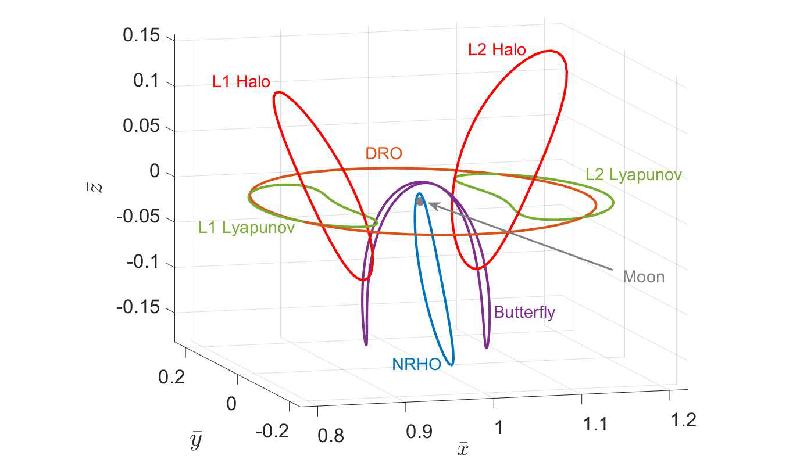
A groundbreaking research paper by I. M. Ross from the Naval Postgraduate School explores a pivotal question in optimal control theory: what are the transversality conditions when boundary conditions are defined by differential equations? This inquiry is particularly relevant for trajectory optimization problems, especially in the context of complex N-body systems.
Transforming Trajectory Optimization
The study presents a novel approach to understanding trajectory optimization beyond traditional algebraic boundaries. In contexts like astrodynamics, where the motion of spacecraft entails intricate calculations influenced by multiple gravitational forces, the classical assumptions of using fixed mathematical equations can fall short. Ross's paper aims to fill this gap by introducing generic initial and final transversality conditions tailored for boundary scenarios defined by differential equations, rather than relying solely on algebraic formulations.
Core Contributions and Methodology
The primary contribution of this research lies in its development of transversality conditions that are more broadly applicable across different dynamical systems. Ross introduces the concept of "coordinated" and "uncoordinated" clock times to articulate the relationship between the time parameters in boundary conditions. This distinction highlights scenarios where time variables deviate from a simple linear association, which is often assumed in classical control problems.
Furthermore, the paper emphasizes the introduction of weak adjoint covectors—a mathematical construct that assists in defining these new transversality conditions. By contrasting with traditional strong definitions, the use of weak adjoint covectors allows for a more nuanced handling of boundary differential equations, opening new avenues for computational applications.
Implications for Future Research and Applications
One of the most compelling aspects of this research is its applicability to real-world problems in aerospace and dynamics, particularly for trajectory optimization in complex gravitational fields. As Ross notes, understanding these transversality conditions can enhance computational methods and robustness in trajectory planning, potentially leading to breakthroughs in spacecraft missions and astrodynamics.
This research lays the foundation for a further exploration of boundary differential equations in optimal control, paving the way for even more sophisticated solutions that can address the complexities inherent in modern scientific challenges.
Concluding Thoughts
Ross's work represents a significant advancement in optimal control theory, as it recognizes and addresses the limitations of traditional algebraic approaches. By broadening the scope of transversality conditions to include differential equations, this research not only enriches academic discourse but also provides practical frameworks that can be directly utilized in cutting-edge aerospace engineering.
For those deeply engaged in the fields of mathematics, engineering, and physics, this paper sets the stage for further innovations and practical implementations that can significantly impact how we understand and navigate dynamical systems.




