
Revolutionizing Post-Quantum Cryptography: System-Level Innovations for Embedded Security on Arm Cortex-M7
In a groundbreaking study, researchers have unveiled a powerful approach to optimizing post-quantum cryptography for embedded systems. Focusing on the Module-Lattice-Based Key-Encapsulation Mechanism (ML-KEM) deployed on the Arm Cortex-M7, this research highlights innovative strategies that transcend traditional instruction-level methods, paving the way for more efficient and secure cryptographic processes.
Understanding the Cryptographic Challenge
As quantum computing advances, traditional cryptographic systems based on integer factorization and discrete logarithms face unprecedented challenges. The rise of large-scale quantum computers threatens the security of these systems, necessitating a transition towards post-quantum cryptography (PQC). The study emphasizes the urgency of implementing ML-KEM, a pivotal component of future secure communication protocols especially vital for embedded and Internet-of-Things (IoT) devices.
The Novel Two-Stage Optimization Methodology
This research introduces a two-stage optimization framework that enhances the performance of cryptographic operations. Initially focused on instruction-level optimizations like assembly tuning and arithmetic improvements, the study progresses to systematically evaluate the broader execution environment. By examining factors like memory placement, hardware integration, and clock configurations, the methodology captures previously untapped efficiencies.
A Focus on Memory and Data Management
One of the significant insights from the study is the optimization of memory usage. The research reveals that employing techniques such as tightly coupled memory and public-data reuse can drastically reduce execution cycles. For example, computing enhanced memory arrangements reduced cycles of encapsulation and decapsulation operations by an astonishing 74.6% and 58.8%, respectively. This demonstrates that optimizing how and where data is stored can provide significant computational advantages without altering the underlying cryptographic algorithms.
Results and Implications for Deployment
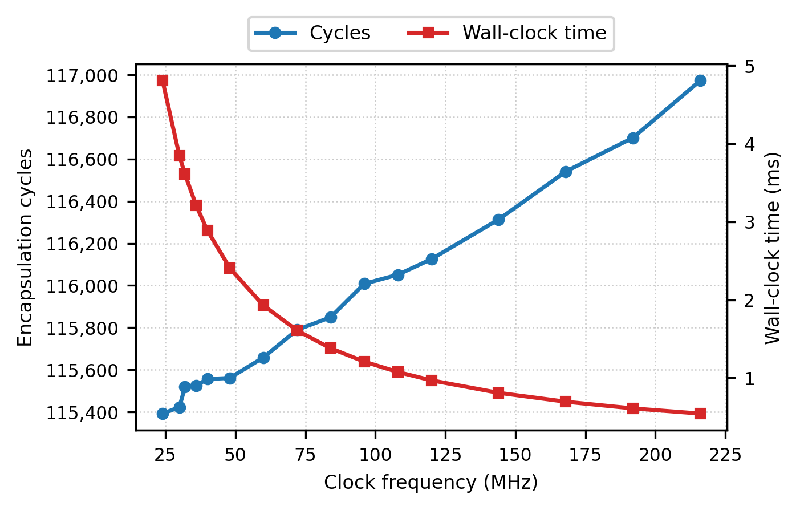
The experimental outcomes highlight that substantial gains can be achieved beyond arithmetic optimizations alone. The optimized profiles, such as the balanced AE-noD-noPK, maintain standardized cryptographic formats while minimizing latency – achieving encapsulation times below 1 millisecond across all tested parameter sets. These findings not only support more efficient deployment in various applications but also inform broader design choices for cryptographic systems.
Guiding Future Research and Development
This research represents a pivotal step in the evolution of embedded cryptographic systems, emphasizing that optimization should not be confined to algorithmic improvements alone. Instead, the interaction between software and hardware configurations plays a critical role. As the study's authors assert, the methodology can guide other researchers and developers in exploring optimization avenues in diverse embedded systems, reinforcing the importance of comprehensive systems-level considerations.
In conclusion, the insights from this research pave new avenues for reinforcing security in the age of quantum computing, promising a future where embedded cryptography can operate both efficiently and securely in an increasingly connected world.
Authors: Mahmoud Abdelhafeez Sayed, Mostafa Taha, Gurp Nijjer


