
Revolutionizing Quantum Interfaces: High-Efficiency Photon-Phonon Conversion Close to Single-Quantum Levels
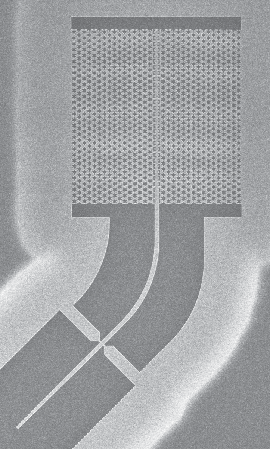
In an exciting breakthrough in quantum technology, a recent study from a group of researchers at the Delft University of Technology and the Instituto de Física Gleb Wataghin has achieved a significant milestone in the realm of optical to mechanical state conversion. The paper titled "Efficient Conversion of Optical to Mechanical States Close to the Single-Quantum Level" details how researchers harnessed advanced optomechanical crystals to enable low-noise photon-phonon state transfers at a level approaching single-quanta.
What's the Big Idea?
The research directly addresses the challenges faced in creating hybrid quantum systems where coherent transfers between optical photons (light particles) and mechanical excitations (the motion of mechanical systems) are critical. These interfaces can pave the way for groundbreaking applications in quantum information processing and phonon-state engineering, essential for the development of future quantum technologies.
How Did They Do It?
The team utilized a technique known as optomechanically induced transparency (OMIT), which allows for effective mapping of optical fields to mechanical modes. By operating at millikelvin temperatures, they significantly reduced thermal noise—a major hurdle in previous implementations where background noise was so high it masked the desired signals.
The remarkable outcome of their method was a photon-phonon conversion efficiency (η) that reached an unprecedented 0.76 while maintaining a mechanical storage lifetime (T1) of 7.3 microseconds. This high efficiency opened up the bandwidth for coherent storage and retrieval of information exceeding 4.5 MHz, making their device one of the best-performing optical interfaces to mechanical modes to date.
Unpacking the Technical Jargon
To simplify, the research moves away from relying on classical light signals with many photons—often muddled by thermal noise—towards using weak coherent signals, accommodating just a few photons at a time. This transition is crucial for future quantum networks, where precise control and manipulation of single photons or phonons will be vital.
Implications for Future Quantum Technologies
The implications of this advancement are vast. As the team establishes optomechanical crystals as a reliable platform for optical-phonon interfacing, the potential for developing efficient quantum memories and enhancing quantum communication protocols becomes increasingly feasible. Their work signifies a stepping stone toward using quantum systems for tasks like long-range entanglement distribution and sophisticated quantum metrology.
The researchers are optimistic that further reducing the added thermal noise will allow for effective operation with genuine single photons, effectively opening the gates to a new era of quantum technologies. As the field of quantum science continues to evolve, this research stands out as a critical contribution to understanding and harnessing the unique properties of quantum systems.
In summary, the work showcases the potential of hybrid quantum systems in advancing our capabilities in storing and processing quantum information. These findings could very likely revolutionize how we think about, utilize, and implement quantum technologies in the near future.
Authors: Alexander Rolf Korsch, Liu Chen, Pedro V. Pinho, Boris Müllendorff, Jan N. Kirchhof, Yong Yu, Thiago P. Mayer Alegre, and Simon Grölbacher.




