
Revolutionizing Recommendation Systems: Unlocking 90% Training Efficiency with Effective Training Time!
In an era dominated by data-driven decision making, improving the efficiency of recommendation systems is paramount. A recent groundbreaking research paper unveils a novel method: Effective Training Time (ETT%), a metric that not only identifies but also quantifies lost training time in large-scale systems. This approach and its accompanying optimizations have showcased the potential to elevate the training efficiency of recommendation systems significantly—up to an impressive 90%.
The Challenge of Training Efficiency
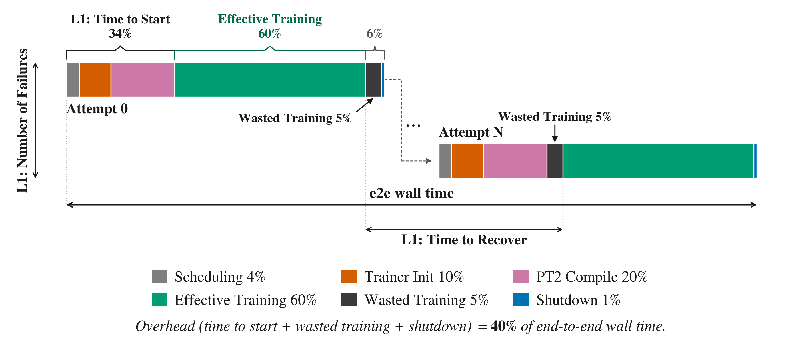
Training recommendation models at scale typically involves processing massive datasets, often reaching tens of billions of training examples daily across thousands of GPUs. However, prior to this research, only 50-60% of the total processing time actually contributed toward training with new data. The rest? It was swallowed by various overhead tasks, such as initialization and recovery from failures. The innovation here is recognizing that this idle time represents a significant capacity loss in resources.
Introducing Effective Training Time (ETT%)
ETT% serves as a comprehensive operational framework that breaks down the end-to-end processing time of training into identifiable segments. It provides a clear snapshot of where time is lost, enabling teams to spot inefficiencies in their workflows. The two-level decomposition of ETT% allows for a granular analysis that links specific losses to particular infrastructure components, paving the way for targeted optimizations.
Optimizations That Make a Difference
The research highlights a multi-faceted approach to optimization along the entire training stack, which includes:
- Communication Elimination: Streamlining metadata handling to reduce unnecessary communication overhead between GPU processes.
- Pipeline Overlap: Adjusting the order of operations to allow various processes to occur in parallel rather than sequentially, significantly slashing initialization times.
- Asynchronous Checkpointing: Implementing a system where the training loop can continue while saving model states, preventing downtime.
- Dynamic Handling and Compilation: Utilizing PyTorch 2 compilation caches and optimizing model transformations to reduce waiting times and improve productivity.
Impressive Results: Metrics that Speak Volumes
Following the implementation of these strategies, tests showed an average improvement in ETT% of 15.5%, with some workloads achieving an astonishing 85% efficiency. Fleet-wide statistics demonstrated that the overall ETT% jumped from around 80% to above 90%, translating directly into greater usage of available GPU resources. This remarkable enhancement not only boosts productivity but also enables more rapid model deployment, crucial for keeping up with fast-changing user preferences.
Conclusion: A Paradigm Shift in Training Recommendation Systems
This study highlights a new standard in the measurement and optimization of training processes within recommendation systems. By focusing on effective training time, the research underscores an often-overlooked dimension in machine learning infrastructure, promising substantial benefits across the board. Moving forward, such insights are poised to reshape how teams approach the training and optimization of machine learning models, championing efficiency and capability as the central tenets of modern computational strategies.
Authors: Mingming Ding, Ruilin Chen, Yuzhen Huang, Hang Qi, Menglu Yu, San Tan, Damian Reeves, Boris Sarana, Kevin Tang, Satendra Gera, Gagan Jain, Sahil Shah, Vishwa Karia, Fuzail Khan, Yashasvi Makin, Edward Z. Yang, Oguz Ulgen, Jia Chen Ren, Laith Sakka, Mayank Garg, Meet Vadakkanchery, Aici Lin, Wei Sun, Mengjiao Zhou, Shuai Yang, Junqing Zhou, Max Leung, Apoorv Purwar, Musharaf Sultan, John Bocharov, Zhenyu Tang, Vivek Trehan


