
Revolutionizing Regression: Discover the Game-Changing Method of Riemannian Regression!
In the realm of statistical analysis, linear regression has long been the gold standard for modeling relationships between variables. However, what happens when the underlying data structure is anything but linear? A fresh perspective comes from a novel approach known as Riemannian Regression, presented by Oldemar Rodríguez, which fundamentally reshapes traditional regression methods.
Understanding the Basics: What is Riemannian Regression?
Traditionally, linear regression relies on the assumption that data resides in a flat, Euclidean space, meaning that it treats all observations equally. But not all datasets adhere to this norm; some have complex, nonlinear structures that can mislead standard regression techniques. Riemannian Regression addresses this challenge by incorporating a sophisticated framework that modifies how data distances are calculated, effectively weighing them based on a local context.
The Power of Local Metrics
At the heart of Riemannian Regression lies the concept of local metrics. Rather than simply considering the straight-line distances between data points, this method uses a similarity matrix derived from advanced algorithms like UMAP, ISOMAP, or DBSCAN. These algorithms help to identify how similar or dissimilar data points are to each other, allowing the regression process to account for inherent data structures instead of enforcing a rigid, global geometry.
Key Innovations and Advantages
The main innovation of Riemannian Regression is the introduction of weighted differences. When two observations are similar, their influence on the overall regression fit is minor, while more distant observations have a greater impact. This nuanced approach allows the model to adapt to varying local densities and relationships within the data.
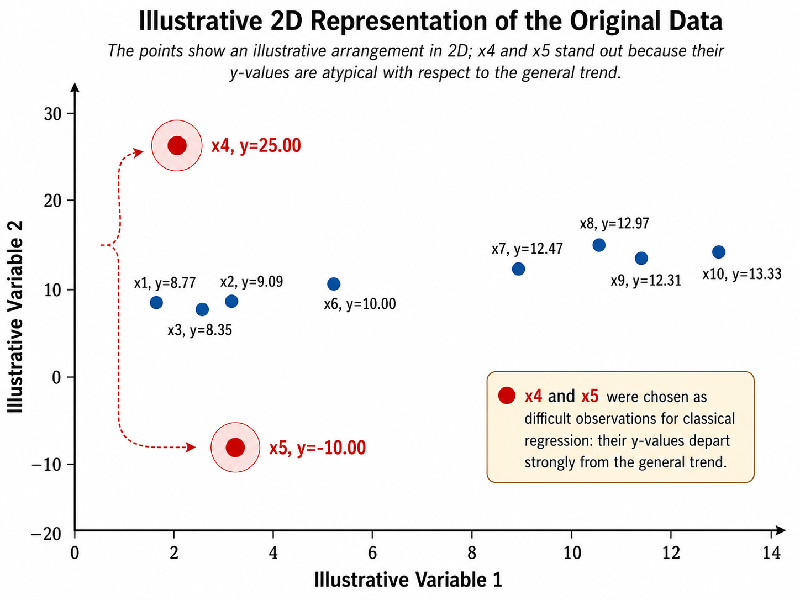
Rodríguez showcases Riemannian Regression through several examples, demonstrating its ability to handle datasets with heterogenous structures. In cases where classical regression struggled, this new method managed to improve the fit significantly, achieving nearly perfect explanatory power in several test scenarios.
Real-World Applications: Is Riemannian Regression the Future?
Field applications hinted at in the research paper include various domains where data complexity and irregularity exist, such as biology, finance, and social sciences. For instance, when applied to the famous Abalone dataset, Riemannian Regression not only outperformed classical methods but also revealed deeper insights into the relationships between physical measurements and growth patterns of abalones. The findings showcased a considerable increase in the coefficient of determination (R²), improving understanding and predictive power.
A Look Forward
The journey for Riemannian Regression is just beginning. As researchers explore and refine this method, it holds the promise of unlocking new possibilities in data analysis, offering more accurate modeling techniques and deeper insights into the structures of complex datasets.


