
Revolutionizing Reliability: How New Insights into Verifier Cascades Transform Large Language Model Evaluation
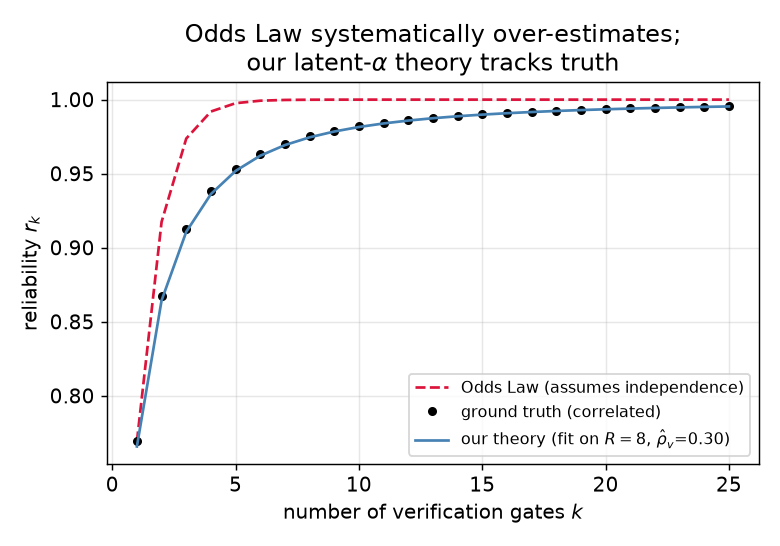
Recent research has unearthed significant advancements in the evaluation process of large language models (LLMs), revealing that traditional assumptions about verification may not hold in practice. The study led by Jiangang Han introduces a novel framework for understanding the reliability of serial verification gates, crucial for enhancing LLM outputs. As AI systems increasingly integrate into decision-making processes, these findings could dramatically reshape how we ensure their accuracy and effectiveness.
Understanding the Framework for Verification
The recently proposed framework breaks new ground in the way we evaluate the correctness of answers generated by LLMs. In the conventional model, a candidate answer is only accepted if it passes through a series of verification gates, where ideally, each gate functions independently. However, this research highlights a critical flaw—errors in LLMs can be correlated, leading to a potential underestimation of failure rates when relying on independent assumptions.
The Blind-Spot Effect and Its Implications
One of the key insights from the research is the 'blind-spot' effect, where a verifier may overlook specific errors produced by the LLM itself. For instance, the study found that an average of 64.5% of errors generated by an LLM went unnoticed when the model evaluated its outputs. This finding underscores the necessity of implementing external checks rather than solely relying on internal mechanisms to self-correct mistakes.
Moving Beyond the Odds Law
The study critiques the existing Odds Law, which suggests that reliability increases exponentially with more gates. Instead, the newly proposed model suggests a polynomial decay in reliability, challenging long-held beliefs and providing a more accurate representation of how increasing the number of gates does not always guarantee improved performance. This adjustment is especially relevant when considering the correlation between errors in LLMs acting as both generators and verifiers.
A Practical Path Forward: Decorrelating Models
One of the most groundbreaking recommendations from Han's research is the need to "decorrelate" verifiers from generators. This could be achieved by using different model families, modalities, or even external tools to check the output. This approach has the potential to significantly improve the detection of errors and enhance overall output quality, making it a valuable direction for future developments in LLM technology.
Final Thoughts: A Shift in LLM Evaluation
This research introduces a paradigm shift in how we perceive the reliability and evaluation of large language models. Understanding the intricacies of verifier cascades and the impact of error correlation introduces a promising avenue for improving AI systems. As we continue to integrate AI into various sectors, these findings will be pivotal in ensuring that the models we rely on are not just powerful but also trustworthy.
As research in this field progresses, embracing these insights could redefine the standards of LLM deployment and evaluation, paving the way for more robust and effective artificial intelligence solutions.
Authors: Jiangang Han




