
Revolutionizing Retrieval Model Evaluation: The New Pooled LLM Approach Saves Time and Costs!
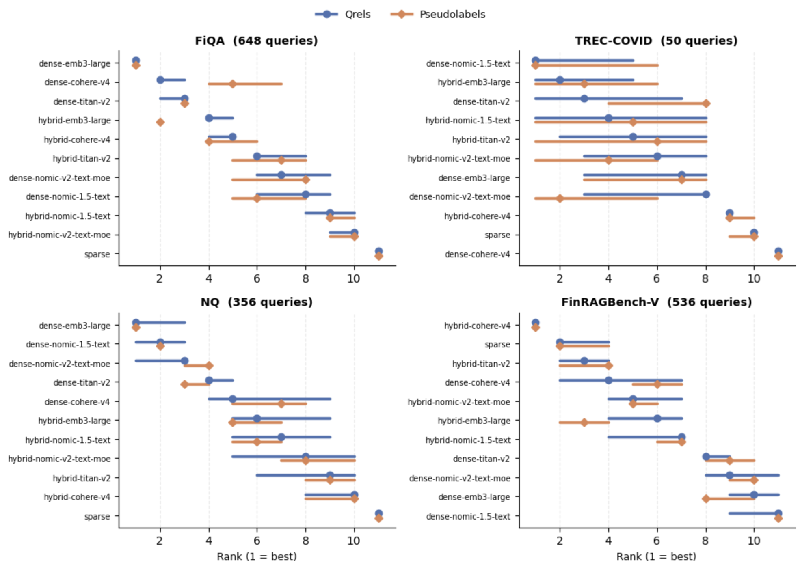
In the fast-paced world of information retrieval, the race to discover which retrieval model performs best is becoming increasingly challenging and costly. Researchers from JPMorganChase, including Max Nelson, Hanoz Bhathena, Aviral Joshi, and Saket Sharma, have introduced an innovative method called the Pooled LLM Evaluation, a technique that significantly streamlines the process while drastically reducing costs.
What is Pooled LLM Evaluation?
The Pooled LLM approach addresses a common issue faced by practitioners: evaluating multiple retrieval models in a reliable yet efficient manner. Traditionally, evaluating these systems requires extensive relevance judgments, a process that can be both time-consuming and expensive. Instead, the Pooled LLM Evaluation harnesses the power of large language models (LLMs) to judge a collective pool of documents retrieved by various systems, incrementally expanding this pool as new models are introduced.
How Does It Work?
The process starts with retrieving documents from several systems for a set of queries. The documents are pooled, and an LLM is tasked with evaluating their relevance. Only newly contributed documents from additional systems need to be assessed, allowing previous evaluations to be reused across the pool. This method not only saves time but also prevents the redundancy of judging overlapping documents, making the evaluation sequence both cost-effective and time-efficient.
Tech-Savvy Cost Reduction
The research found staggering results: when applied to a financial news question-answering system, this approach yielded a remarkable cost reduction of up to 4.9 times over conventional methods. With 65-80% of judgments reused across different systems, companies can now test new retrieval candidates without incurring additional costs tied to previous assessments. This reduction is excellent news for companies continuously adapting to a rapidly evolving tech landscape!
Stability and Accuracy Assessment
One of the significant advantages of the Pooled LLM Evaluation is its ability to maintain ranking stability as new systems are added. The researchers tested this by incrementally adding new models into the pool and found that 97% of pairwise rankings remained consistent over time when bootstrap uncertainty was accounted for. This suggests a high level of reliability in the ranking outcomes produced by the LLM evaluations, making it a robust tool for industry practitioners.
A Practical Solution for Ongoing Benchmarking
This new method presents a practical framework for organizations that rely on retrieval-augmented systems. With the Pooled LLM approach, businesses can continually update and benchmark their retrieval models as new systems are developed, without demanding extensive resources. By transforming how retrieval model evaluations are conducted, this research promises to empower teams to enhance their information retrieval capabilities drastically.
The future of retrieval model evaluation is brighter than ever, thanks to the Pooled LLM Evaluation framework. As more organizations embrace these cutting-edge methods, we can expect faster, cost-efficient, and more accurate information retrieval processes that keep pace with the rapidly changing digital environment.
Authors: {Max Nelson, Hanoz Bhathena, Aviral Joshi, Saket Sharma}




