
Revolutionizing Risk Control in Predictive Models: Discover the Power of ReCIRC
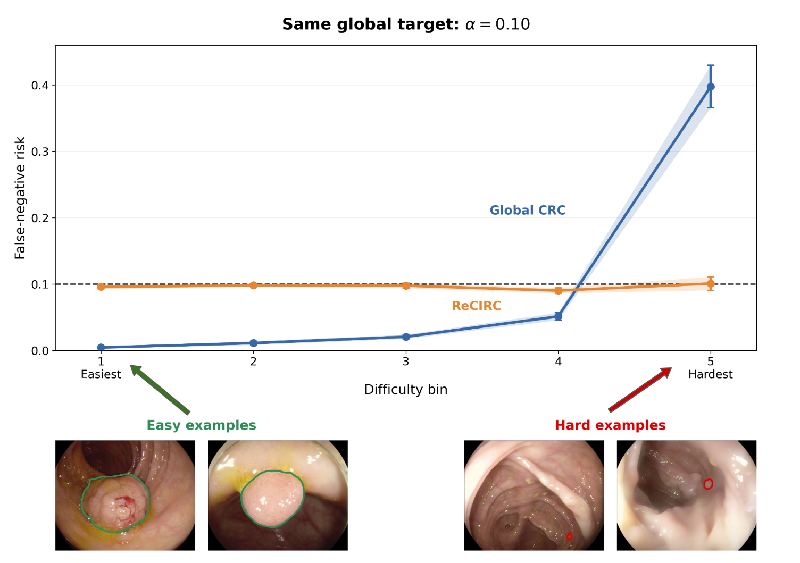
In the ever-evolving field of machine learning, the ability to accurately control error rates in predictive models can significantly impact high-stakes applications like medical imaging or critical classification tasks. A recent study reveals a groundbreaking approach to risk management in predictive modeling called Rectified Conformal Risk Control (ReCIRC), which stands to redefine how we understand and manage prediction inaccuracies.
The Need for Enhanced Risk Control
Traditional methods of controlling prediction error rates have relied on conformal risk control (CRC), which, while effective, often uses a single global threshold shared by all inputs. This approach can lead to erratic performance across different inputs, where simpler cases are over-protected and complex instances are not adequately safeguarded. The problem arises because the risk associated with predictions typically varies with the input, leaving many situations poorly managed.
Introducing ReCIRC: A New Paradigm
ReCIRC addresses these shortcomings by introducing a reparameterization of the risk control framework. Instead of a single global threshold, ReCIRC defines a risk budget that allows each input to have its own specific threshold based on its estimated risk profile. This innovation transforms the way models manage risk, ensuring higher fidelity in predictions for both simple and complex cases.
How ReCIRC Works
At its core, ReCIRC evaluates the local risk curves for individual inputs, effectively allowing the model to tailor its predictions to the specific context. The researchers found that by utilizing these curves, the model could yield more accurate results, particularly in high-stakes scenarios, all while retaining strong guarantees on the model's overall predictive performance.
The practical implementation of ReCIRC involves estimating the local risk curves from a risk-training dataset before finalizing the prediction model through calibration on a separate dataset. This structured approach achieves remarkable results across diverse applications, including medical imaging and text classification tasks.
Promising Results from Comprehensive Testing
The effectiveness of ReCIRC has been evaluated across eight different scenarios, both synthetic and real-world datasets, and has consistently shown lower average risks compared to traditional methods. For instance, in scenarios dealing with polyp segmentation, ReCIRC reduced the overall error rate substantially, proving its ability to balance protection across various input complexities without sacrificing performance on easier cases.
A Look Ahead: The Future of Predictive Modeling
As ReCIRC sets a new standard for risk control in predictive modeling, it opens the door to further research and enhancements. Future applications might involve integrating ReCIRC with other adaptive methodologies to create even more robust and flexible prediction models.
In conclusion, ReCIRC not only offers a sophisticated solution to the risk variability inherent in traditional models but also invites the predictive modeling community to rethink and explore enhanced risk management strategies that will improve outcomes across numerous fields.
Authors: Bruno Marcondes e Resende, Helton Graziadei, Thiago Rodrigo Ramos, Rafael Izbicki


