Revolutionizing Road Safety: A Game-Changing AI Pipeline for Fine-Grained Vehicle Classification
A new study from researchers at the University of Michigan-Dearborn, led by Gandhimathi Padmanaban and Fred Feng, introduces an innovative open-source two-stage computer vision pipeline aimed at improving cyclist safety by enhancing vehicle classification accuracy on roadways. This research addresses a significant gap in automated vehicle categorization systems and their impact on understanding injury risks for cyclists during overtaking incidents.
The Need for Fine-Grained Vehicle Classification
With cycling fatalities rising sharply—from 786 deaths in 2010 to 1,105 in 2022 in the U.S.—recognizing the specific types of vehicles involved in these accidents is crucial. Studies have revealed that larger vehicles like SUVs and trucks are significantly more likely to lead to severe injuries for cyclists compared to standard passenger cars. The challenge, however, lies in the current lack of automated tools capable of distinguishing between vehicle body types effectively, especially from typical roadway video feeds.
A Two-Stage Approach to Vehicle Classification
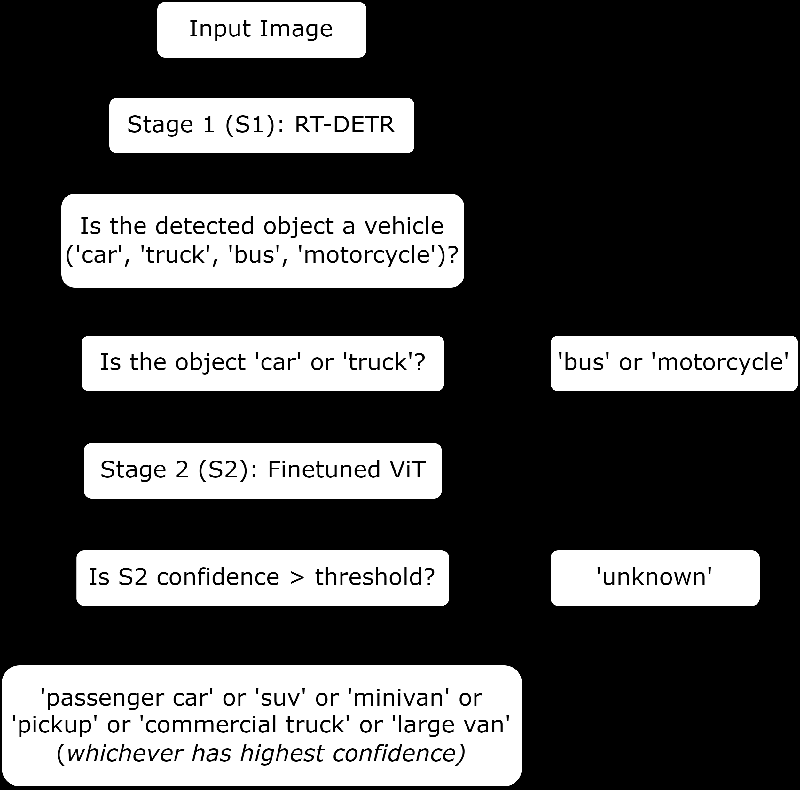
The researchers developed a two-stage detection pipeline that first uses a pre-trained RT-DETR (Real-time Detection with Transformers) model to locate vehicles. In a second stage, the system employs a fine-tuned Vision Transformer (ViT-Base/16) to classify these vehicles into six specific categories: passenger car, SUV, pickup truck, minivan, large van, and commercial truck.
This method not only improves classification accuracy but introduces a confidence-based abstention mechanism that prevents misclassifications when the confidence level is below a set threshold (0.60). Instead of guessing a label when uncertain, the system outputs 'unknown,' thus ensuring that errors do not go undetected.
Impressive Results and Evaluation
The pipeline underwent rigorous testing using 3,805 annotated overtaking events from bicycle lanes in Ann Arbor, Michigan, achieving an overall classification accuracy of 94%. Importantly, it performed well not only on in-distribution data but also maintained a strong accuracy of 89% when tested with data collected from different locations, demonstrating its robustness across various scenarios.
The evaluation results indicated that, while SUVs and passenger cars scored high in classification accuracy (F1 scores of 0.97 and 0.94, respectively), the pipeline faced challenges classifying minivans, primarily due to increased uncertainty which led to a higher rate of classified unknowns.
Open-Source and Future Implications
One of the key contributions of this study is its commitment to reproducibility and accessibility, as the entire pipeline, including its evaluation utilities and fine-tuned model weights, is freely available to researchers and practitioners. By facilitating automated vehicle-type annotation through existing roadside video, this tool can significantly aid in exposure analyses for cycling risks and contribute to better urban planning and legislative measures related to cyclist safety.
The research highlights a crucial step forward in using computer vision technology to enhance transportation safety, particularly for vulnerable road users like cyclists. Future directions include the potential for temporal aggregation techniques to further improve classification accuracy and reliability in dynamic conditions.

