
Revolutionizing Robot Learning: Discover How InterEvolve Adapts Humanoid Skills in Real Time
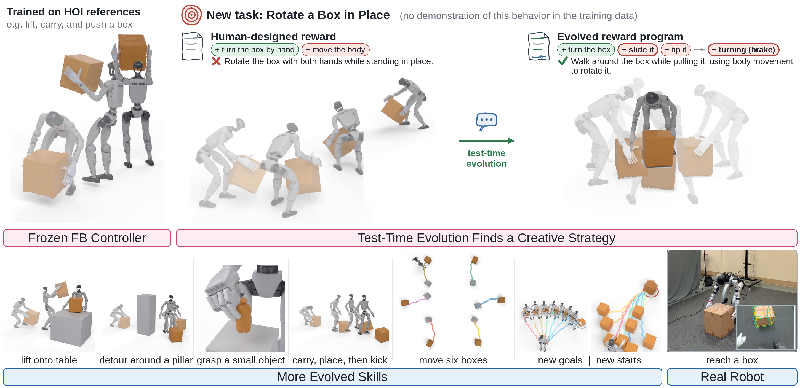
The field of humanoid robotics is set to undergo a transformation with the introduction of InterEvolve, a groundbreaking approach aimed at enhancing the capabilities of humanoid robots during real-time operations. Developed by researchers from the University of Illinois Urbana-Champaign, this innovative methodology enables robots to adapt their skills for tasks they have never encountered before, all without needing extensive retraining. This capability could pave the way for more intelligent and responsive robotic systems in various real-world applications.
The Challenge of Unforeseen Tasks
Humanoid robots are trained to perform specific tasks based on human demonstrations. However, they often face new challenges in unpredictable environments—such as needing to manipulate a box in a way they were never explicitly taught. InterEvolve addresses this problem by leveraging existing skills and optimizing them for new tasks on-the-fly. The key idea is that a fundamental understanding of movement remains within the predefined skills of the robot, and this knowledge can be repurposed effectively.
Innovative Components of InterEvolve
InterEvolve introduces two major components to facilitate this adaptation:
- Object-Aware Behavioral Foundation Model: This model translates complex reward functions—like moving an object or navigating obstacles—into actionable behavior for the robot during its operation. It retains the core movements acquired during initial training and enhances them to suit new tasks.
- Reward Programs: Tasks are broken down into structured rewards that can be fine-tuned dynamically based on the robot's performance and its environment feedback. These rewards outline multiple steps necessary for completing a task, allowing the robot to evaluate and adjust its actions continuously.
How It Works
InterEvolve operates in a two-loop system. The first loop uses a large language model (LLM) to generate new reward programs based on real-time feedback from the robot's performance. As the robot completes each trial, feedback is collected and analyzed, allowing the LLM to revise its understanding of what strategies are most effective for the task at hand.
The second loop employs numerical optimization techniques to fine-tune the parameters of these reward systems, improving task execution based on historical performance data. This self-evolutionary process means that each time the task is executed, the robot learns and improves its approach, resulting in higher success rates and adaptability.
Impressive Results and Future Implications
Experiments with InterEvolve demonstrated impressive advancements in task execution, even in complex and unforeseen scenarios. The robots successfully adapted their skills to perform a wide range of tasks—from lifting and carrying to kicking and pushing objects—often outperforming traditional fixed-program approaches that require extensive retraining for every new task.
This technology hints at a future where humanoid robots could operate alongside humans in diverse settings, capable of learning and adapting without constant oversight, thus greatly enhancing their utility in areas like logistics, healthcare, and service industries.
Conclusion
InterEvolve represents a significant leap in humanoid robotics, combining the powers of behavioral modeling with dynamic learning and adaptation. As this technology matures, it opens the door for more autonomous, resilient, and intelligent robotic systems capable of meeting the challenges of unpredictable environments head-on.
For those interested in the technical details, the full research paper by Zhuo Lin, Sirui Xu, Liuyu Bian, Yu-Xiong Wang, and Liang-Yan Gui can be accessed here.


