
Revolutionizing Robot Skills: How the RPG Framework Boosts Task Success Rates to 95%
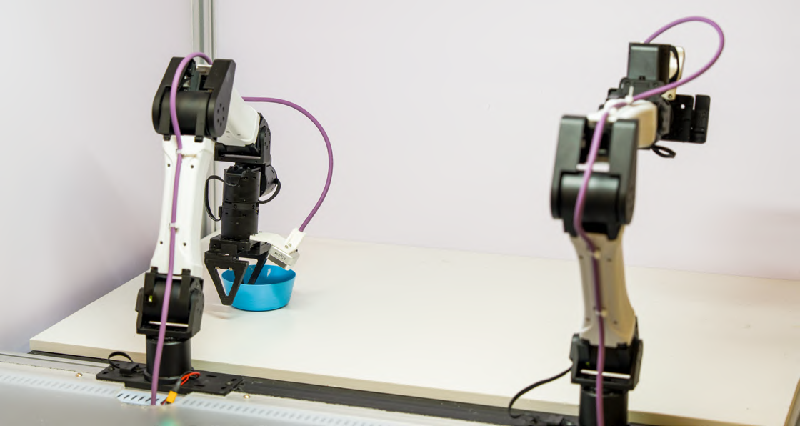
In a landmark study, researchers from UC Berkeley and Amazon have unveiled an innovative framework named Reconstruct, Practice, Go Real (RPG) that enhances robotic capabilities through autonomous self-improvement. Remarkably, this new approach has led to an impressive jump in task success rates from just 28.6% to an astounding 95.0% after only 15 iterations of practice.
What is RPG?
The RPG framework is designed to streamline the process of embedding reusable robotic skills and adapting them to real-world tasks without the need for manual model adjustments. By leveraging an offline dataset, RPG can identify manipulation capabilities optimized for various tasks and compile them into practice sessions. This framework enables a more efficient method for robots to learn and improve their execution rapidly.
How RPG Works
The RPG process consists of three phases: Reconstruct, Practice, and Go Real. During the Reconstruct phase, the framework analyzes an offline dataset to identify useful manipulation capabilities that can be translated into simulation tasks. The Practice phase involves a two-agent approach where the Runtime Agent and a Privileged Agent execute tasks. The Privileged Agent receives additional data from the simulation environment, allowing for more successful executions and detailed diagnostic feedback.
Finally, the Go Real phase adjusts the refined skills gathered from practice for physical robot deployment. The culmination of this structured learning process results in robotic systems that not only understand core tasks but can also adapt and improve without further human assistance.
Unprecedented Achievements
During testing, the RPG framework demonstrated significant efficacy, achieving a success rate of 95.0% on held-out manipulation tasks, starkly surpassing existing models like ASPIRE and GPT-6 powered CaP-Agent0, which only managed 75.5% and 60.0%, respectively. This represents a transformative leap in robotic task execution capabilities, highlighting RPG's potential to revolutionize autonomous robotics.
More Than Just Numbers: Practical Implications
The implications of RPG extend beyond improved statistics. By facilitating robots' ability to autonomously learn and adapt, this framework opens doors to deploying robots in nuanced and dynamic environments, ranging from domestic tasks such as folding towels to more complex arenas like robotic surgery. The advancements could enable smoother human-robot interaction, ushering in a new era of collaborative robotics in everyday life.
Conclusion
The Reconstruct, Practice, Go Real framework has ushered in a paradigm shift in the evolution of robotic capabilities, offering a robust, scalable, and efficient approach to skill acquisition and task execution. With a demonstrated ability to learn and adapt autonomously, robots may soon be equipped to handle an even wider array of real-world tasks, ultimately leading to smarter, more reliable machines in various sectors.


