
Revolutionizing Sparse Matrix Optimization: The Power of Reinforcement Learning in Graph Transformation
A new research paper introduces a groundbreaking framework utilizing reinforcement learning (RL) to optimize sparse triangular solve (SpTRSV) operations, a fundamental component in many scientific and engineering applications. Authored by Buse Yılmaz from MEF University, this innovative approach seeks to address the challenges posed by the data dependencies inherent in sparse triangular matrices, which hinder efficient parallel execution and workload distribution.
Understanding Sparse Triangular Solve (SpTRSV)
SpTRSV is a process used to solve linear equations where the coefficient matrix is a sparse lower triangular matrix. The complexity arises due to the dependencies between the equations, represented as a directed acyclic graph (DAG). If not managed properly, these dependencies can significantly slow down calculations, especially when trying to leverage parallel processing capabilities.
The Challenge of Graph Transformation
Traditionally, optimization strategies for SpTRSV have involved heuristics—manually designed rules to modify the matrix's dependency graph. These methods often fall short as they can be complex and may not adapt well to varying optimization objectives. The paper proposes a novel solution: transforming the graph using a reinforcement learning-based framework that learns and adapts over time, eliminating the need for rigid heuristics.
The Reinforcement Learning Approach
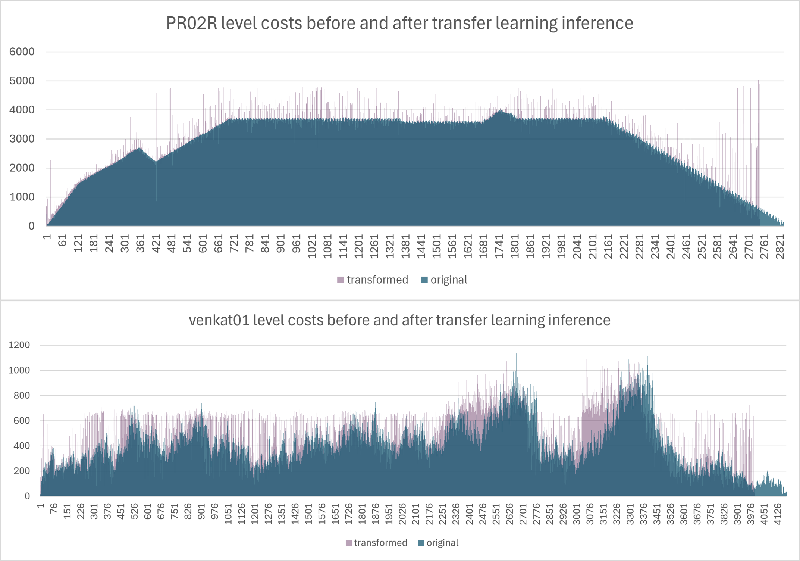
In this new framework, graph transformation is treated as a sequential decision-making problem. The RL agent explores different transformation policies by interacting with the environment, learning to modify the graph in ways that improve execution efficiency. This method has shown to reduce the levels in the graph by an impressive 94% and the coefficient of variation (a measure of workload balance) by up to 80%, while rewriting only a small fraction of the rows.
Real-World Impact and Experimental Results
The research demonstrates that the RL-based strategy not only achieves substantial reductions in both the number of levels and their associated costs but also manages competing optimization objectives effectively. For instance, even though heuristic methods might perform better in sheer level reduction, the RL approach outshines in balancing workload across the levels, showcasing its dual strength in optimization.
Future Directions and Broader Applications
Looking ahead, the authors emphasize the need to expand the dataset for training the RL models and explore implementation across different solver architectures. Importantly, this framework not only paves the way for improved computational performance in sparse triangular solves but also lays the groundwork for further research into intelligent optimization strategies across various applications in scientific computing.
This research illustrates how machine learning can significantly enhance traditional computational techniques, offering a promising avenue for future technological advancements in algorithm optimization.


