
Revolutionizing Trading: The Hybrid Learning Approach of PPO-HRAP for Risk Control
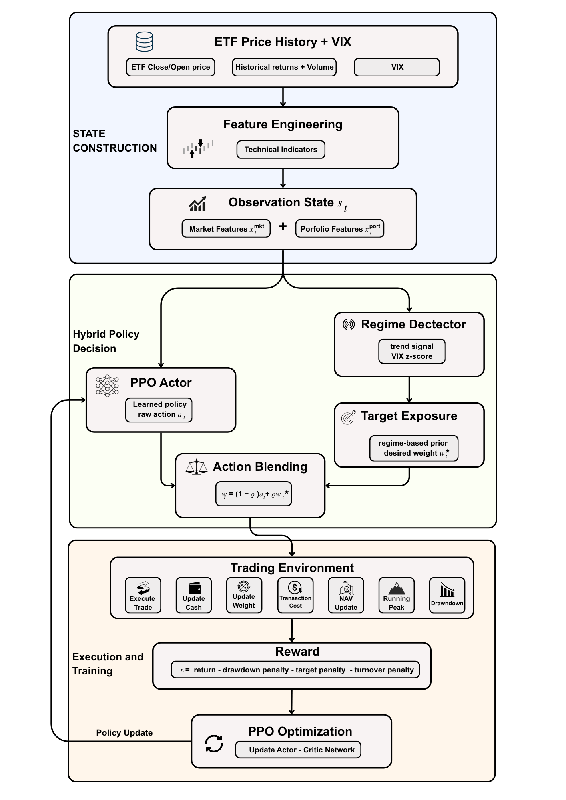
In the fast-paced world of trading, navigating market volatility while maximizing profits is a challenging endeavor. Conventional reinforcement learning strategies often emphasize profitability but can falter when faced with market downturns. A new research paper proposes an innovative solution: the PPO-HRAP, a hybrid regime-aware trading policy designed to strike a balance between risk and reward.
Understanding the Challenges of Trading with AI
Most algorithms prioritizing profits can lead to risky trading behavior, as they may end up heavily invested in rising markets without adequately managing potential losses. Conversely, those that penalize risk aggressively often hold back on returns during turbulent market conditions. This has resulted in a pressing need for a trading model that considers both rewards and risks.
The Breakthrough of PPO-HRAP
The PPO-HRAP, developed by researchers Duong Hien Chi Kien and Huynh Thanh Trung at VinUniversity, merges Proximal Policy Optimization (PPO) with a regime-aware policy. The approach involves teaching the system to recognize different market environments and adjust its investment strategies accordingly. By observing both market and portfolio characteristics, PPO-HRAP aims to mitigate risk while still pursuing profits.
During testing from 2020 to 2022, PPO-HRAP reportedly achieved an impressive total return of 27.62%, with a significantly reduced maximum drawdown from 34.10% for traditional “Buy and Hold” strategies down to 18.47%.
How Does It Work?
The PPO-HRAP uses a sophisticated reward system that combines various factors: portfolio returns, penalties for increasing drawdowns (losses), exposure deviations, and transaction costs. This multifaceted reward structure enables the trading agent to weigh its options more thoughtfully during decision-making.
Moreover, the method introduces an interpretable regime prior, which helps the trading policy to adapt to different market conditions without losing sight of its learning objectives. It essentially blends historical market data with real-time actions to optimize trading strategies actively.
Evaluating Performance and Stability
PPO-HRAP not only surpassed other methods in total return but also achieved the highest Sharpe, Sortino, and Calmar ratios among models tested. These metrics are pivotal as they measure risk-adjusted returns, revealing a more comprehensive picture of the trading strategy's performance. Importantly, the approach remains stable across variable seeds, indicating it can maintain performance even under different market scenarios.
The Road Ahead: Potential and Limitations
While PPO-HRAP demonstrated promising results, including leading performance across multiple assets like QQQ and DIA, researchers caution about its limitations. High turnover rates indicate that while managing risk, the strategy might incur significant transaction costs. Moreover, further validation across different markets and longer training periods are essential for gauging its robustness.
This groundbreaking research highlights the importance of combining learning with structured controls in trading algorithms. By preparing for various market regimes, PPO-HRAP paves the way for a new era of risk-aware trading, showcasing a smart and efficient approach to portfolio management.
Authors
Duong Hien Chi Kien - 24kien.dhc@vinuni.edu.vn, College of Engineering and Computer Science, VinUniversity, Ha Noi, Viet Nam
Huynh Thanh Trung - trung.ht@vinuni.edu.vn, College of Engineering and Computer Science, VinUniversity, Ha Noi, Viet Nam


