
Sampling Secrets Unveiled: Why Current Techniques Fall Short with Multimodal Distributions
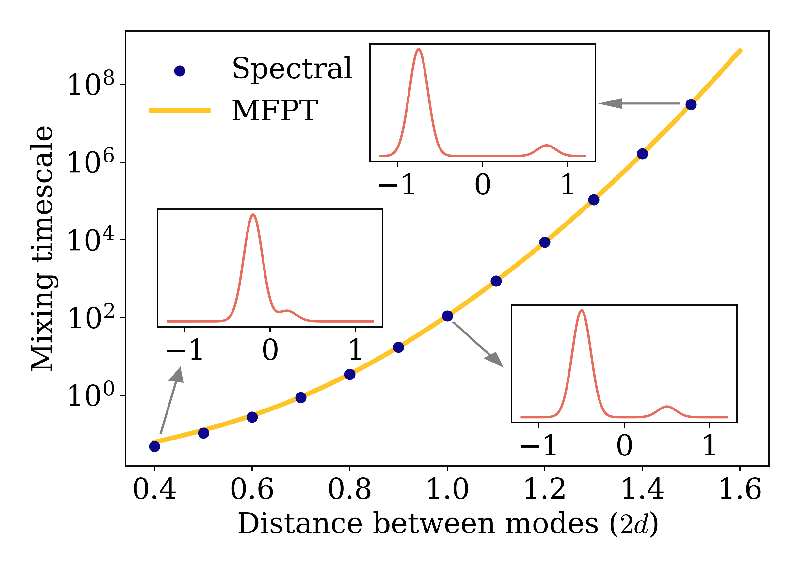
Recent advancements in sampling algorithms, particularly those utilizing Wasserstein gradient flows and forward-only diffusion processes, have transformed the landscape of statistical physics and machine learning. However, a provocative new study raises questions about the true efficacy of these methods for complex multimodal distributions.
Understanding the Challenge of Multimodal Sampling
The goal of sampling from a distribution often involves creating independent and identically distributed (i.i.d.) samples from potentially challenging target densities. This process has crucial applications across domains such as statistical physics and Bayesian inference. However, the challenge intensifies in scenarios featuring multimodal distributions, where distinct peaks in the data can complicate sampling procedures.
Key Findings of the Study
The paper, authored by Daniel McBride, Pratik Khandagale, Cristina Garcia-Cardona, and Yen Ting Lin from Los Alamos National Laboratory, critically examines the effectiveness of sampling techniques based on Wasserstein gradient flows (WGF) and forward-only diffusion processes (FODP). The researchers argue that despite theoretical assurances of rapidly converging to the target distribution, these methods face fundamental limitations when applied to well-separated modalities.
The Core Argument
By employing the Jordan–Kinderlehrer–Otto (JKO) scheme and Otto calculus, the authors demonstrate that sampling dynamics based on WGF and FODP share similarities in their density evolution. This connection indicates that both approaches can inherit the same slow-mixing phenomena found in nonequilibrium statistical physics. Specifically, when target distributions feature distinct, well-separated modes, the dynamics governing WGF and FODP yield exponentially long mixing times. In practical terms, this translates to inefficient sampling, making it computationally infeasible for complex, multimodal distributions.
Two Analytical Tools: Spectral and Mean First-Passage Time Analysis
The researchers employed two complementary analytical tools—spectral analysis and mean first-passage time (MFPT) analysis—to illustrate their points. They show that small spectral gaps and rare transitions between modes lead to prolonged mixing times. For instance, using an annealing schedule intended to smoothly transition the samples between modes does not alleviate these inherent delays.
Implications for Current Sampling Techniques
This work urges reconsideration of widely used sampling methods based on local, gradient-driven approaches. In particular, the findings suggest that simply introducing intermediate distributions or employing methods inspired by WGF and FODP, without incorporating nonlocal mechanisms, may not provide a viable solution for effective multimodal sampling.
Path Forward: Exploring Nonlocal Mechanisms
The conclusions drawn from this research indicate a need for developing sampling methods that incorporate nonlocal information. Approaches like Annealed Flow Transport Markov Chain Samplers (AFTMC) or other recent innovations that allow for greater flexibility in transitions could offer pathways to improve sampling efficiency in multimodal contexts. The authors highlight that overcoming these fundamental limitations requires new methodologies beyond traditional gradient-based sampling.
In summary, while WGF and FODP have contributed significantly to our understanding of sampling, the call for a shift in methodology highlights an ongoing challenge in statistical modeling—a challenge that, if met with innovative solutions, could enhance our ability to tackle complex statistical problems effectively.
Authors: Daniel McBride, Pratik Khandagale, Cristina Garcia-Cardona, Yen Ting Lin


