
StreamRig: The Future of Multi-Camera Odometry Unveiled!
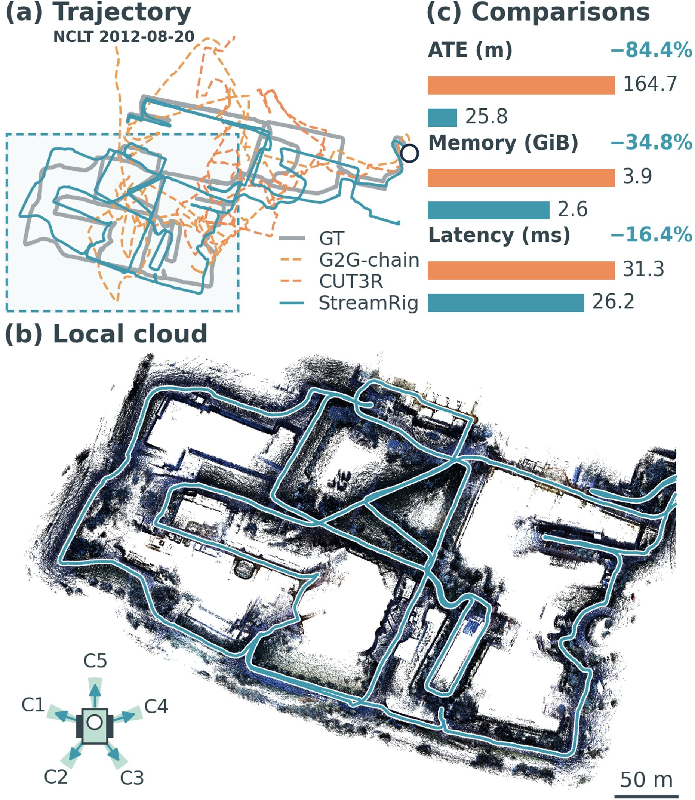
Researchers have recently introduced a groundbreaking framework called StreamRig, which significantly enhances how mobile robots and autonomous vehicles utilize synchronized multi-camera rigs for 3D spatial awareness. Traditional methods often struggle with efficient use of the geometric relations among cameras, but StreamRig leverages a new "freeze-and-stream" approach that sets a new standard in streaming multi-camera odometry.
The Challenge of Multi-Camera Systems
In an era where mobile robots are equipped with a plethora of cameras to perceive their surroundings, the challenge has been how to efficiently process and utilize the vast amount of visual data they collect. Many existing streaming 3D models are optimized for monocular inputs, which means that multi-camera setups often do not take full advantage of their geometric relationships—leading to compromised motion estimation.
StreamRig addresses this issue with innovative modules that allow synchronized multi-camera rigs to operate efficiently. By maintaining a frozen multi-view 3D foundation model, StreamRig effectively reduces latency and enhances pose estimation accuracy for better navigation and interaction in complex environments.
The Core Mechanism of StreamRig
At its heart, StreamRig uses a combination of three lightweight modules designed to handle the unique challenges posed by multi-camera rigs:
- Rig-Resampler: This module compresses the features from individual camera feeds into a manageable set of latent tokens, allowing for quicker processing.
- CausalBridge: It applies causal attention, ensuring that each camera can efficiently use information from its past inputs while maintaining low memory usage.
- Pose Head: This regresses the pose of the rig by estimating its position and orientation based on the information provided by the CausalBridge.
The clever design allows StreamRig to efficiently calculate temporal states using compressed geometric observations, which not only enhances its accuracy but also keeps computational costs low.
Impressive Results Across Multiple Datasets
In tests across various datasets, including the NCLT, TartanGround, KITTI-360, and the newly developed ZJH humanoid-robot dataset, StreamRig demonstrated remarkable performance. It achieved lower translation and rotation drift than both traditional monocular streaming methods and other rig-aware offline models.
StreamRig's innovative approach allowed it to achieve superior accuracy without sacrificing inference costs, making it a highly efficient solution for real-time applications in mobile robotics.
Conclusion: A Leap Forward for Robotics
StreamRig represents a pivotal advancement in the field of multi-camera odometry, showcasing a smart blend of perception and temporal reasoning. By addressing the challenges associated with traditional systems and leveraging a frozen multi-view 3D model, it promises to enhance the capabilities of mobile robots navigating real-world environments.
This research not only highlights the importance of integrating advanced geometric frameworks into practical applications but also sets the stage for future developments in streaming and autonomous navigation technologies.
For those interested in exploring the code and further details about StreamRig, it is available here.
Authors: Yufei Wei, Shuhao Ye, Qi Wang, Xin Zheng, Qing Huang, Rong Xiong, and Yue Wang


