
Supercharge Your Avatars: GALA Makes Real-Time Animation a Breeze!
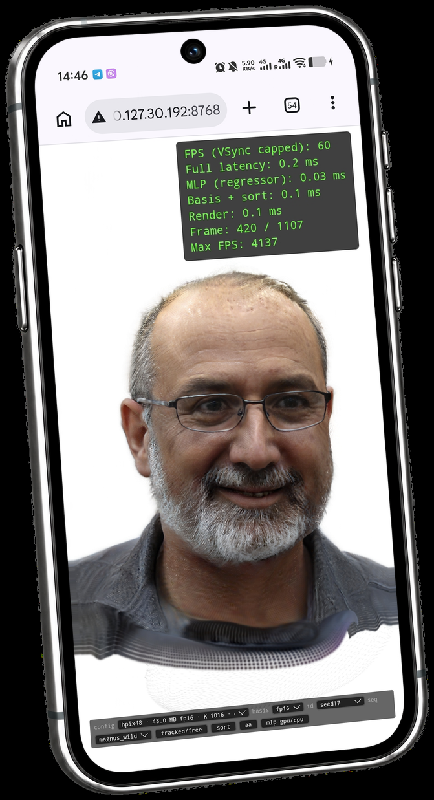
In the rapidly evolving world of digital avatars, creating lifelike animations that can be rendered in real-time has always been a monumental challenge. Recent research from Ramazan Fazylov and his colleagues introduces a groundbreaking technique dubbed GALA (Gaussian Animation via Linear Approximation) that promises to revolutionize the animation of 3D avatars. This innovative method could allow developers and creators to deploy advanced avatar technology directly on mobile devices and across various platforms.
The Challenge of Real-Time Animation
While existing 3D Gaussian avatars enable fast rendering, their real-time animation often requires intensive computational resources. Traditional frameworks demand evaluations of complex neural networks at every frame, making the process cumbersome and often prohibitive for mobile devices. GALA seeks to dismantle this bottleneck by approximating the animations using a much simpler mathematical framework.
What Sets GALA Apart?
GALA's core innovation lies in its unique approach to avatar animation. Instead of relying on per-frame neural decoding, which can be computationally heavy, GALA utilizes a shared blendshape basis that is independent of identity. This means that once the necessary parameters are identified, they can expedite the animation process significantly—by up to three orders of magnitude—allowing for animations to be processed at frame rates as high as 60 frames per second on mobile platforms.
Moreover, GALA employs a lightweight network to predict the coefficients needed for animation, resulting in dramatic reductions in CPU load and memory use without compromising on quality. This accessibility opens the doors for new applications of AVATAR technology in gaming, virtual reality, and beyond.
Technical Insights Made Simple
The researchers discovered that the animated outputs from various Gaussian avatar models could be closely simulated by a linear combination of specific facial features known as blendshapes. By analyzing differences between neutral avatars and their animated states, GALA crafts a basis that generalizes across different identities. In practice, this means one can create diverse and responsive avatar animations that don't require retraining for each new identity or scenario.
Promising Results
The results from applying GALA on three different avatar models (including those for head generation and full-body animation) showcased remarkable improvements. They demonstrated a significant cut in CPU workload while maintaining high-quality rendering outputs that exceed previous standards. For developers, this translates into faster processing times and the ability to create more complex and interactive environments without the heavy computational burden.
Conclusion and Future Prospects
With GALA, the future for real-time avatar animation looks bright. This technique not only sets a new benchmark for performance but also lays the groundwork for more interactive and immersive user experiences in a range of fields from gaming to virtual collaboration. As avatars become an increasingly integral part of our digital lives, innovations like GALA will make them more expressive and accessible than ever before.
For a deeper look into GALA, check out the project page here.
Authors: Ramazan Fazylov, Stamatis Lefkimmiatis, Ivan Laptev


