
Transforming Document Retrieval: How MIDR Enhances Multimodal Indexing for Better Content Discovery
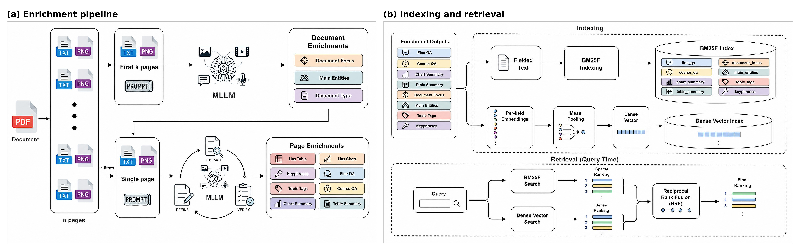
In an era where data is abundant, efficiently extracting relevant information from visually rich documents poses significant challenges. A recent study introduces MIDR (Multimodal Indexing for Document Retrieval), a groundbreaking approach that shifts the process of multimodal reasoning to index time rather than query time, enabling more effective retrieval of information contained in tables, charts, and other visual layouts.
The Challenge of Visual Content in Document Retrieval
Traditional methods for retrieving information, especially from documents with complex visual elements, have relied heavily on OCR (Optical Character Recognition) technology. However, OCR often fails to capture the intricate relationships and structures present in tables and charts, reducing the effectiveness of search results. This limitation is particularly critical in sectors like finance, medicine, and research, where key data often resides in non-linear formats.
Introducing MIDR: A New Framework for Document Retrieval
MIDR offers a fresh approach to address these challenges. Instead of processing image representations during retrieval, MIDR utilizes a multimodal large language model (MLLM) during the indexing phase. This allows the model to convert rendered page images into structured textual representations that encompass various document aspects, such as attributes and layout-dependent data.
The framework implements a methodology called enrichment-augmented indexing, where key information is extracted and verified before being indexed, which leads to a more efficient search process. This shift not only reduces the computational load during retrieval but also enhances the accuracy of the information served to users.
Key Findings and Performance Metrics
In tests conducted on the ViDoRe V3 benchmark, MIDR Hybrid achieved an impressive 0.6219 average nDCG@10 score, marking a 23% improvement over the raw BM25 algorithm. It also managed to outshine contemporaries like ColQwen2.5 in specific document domains while using approximately nine times less index memory and halving query latency.
Additionally, when tested across French document domains, MIDR effectively bridged language gaps by translating layout-grounded evidence into English at index time, significantly improving retrieval effectiveness in cross-lingual contexts.
Conclusion: The Future of Multimodal Document Retrieval
MIDR illustrates a paradigm shift in multimodal document retrieval by emphasizing efficient ingestion and indexing practices over real-time complex visual processing. As organizations grapple with vast amounts of data in diverse formats, methods like MIDR pave the way for smarter, faster, and more accurate information discovery.
The potential applications of this framework extend beyond traditional document retrieval. By refining how data is indexed and retrieved, MIDR could transform various sectors, improving the accuracy of legal documents, financial reports, and scientific publications, ultimately leading to more insightful decision-making processes.
For further inquiries or to explore implementation, reach out to the authors Debanjan Mahata, Atharva Tendle, Daniel Preo¸tiuc-Pietro, Yong Zhuang, and Ozan ˙Irsoy at their respective Bloomberg emails.




