
Transforming Mental Health Annotation: A New Self-Evolving Framework for Enhanced Depression Diagnosis
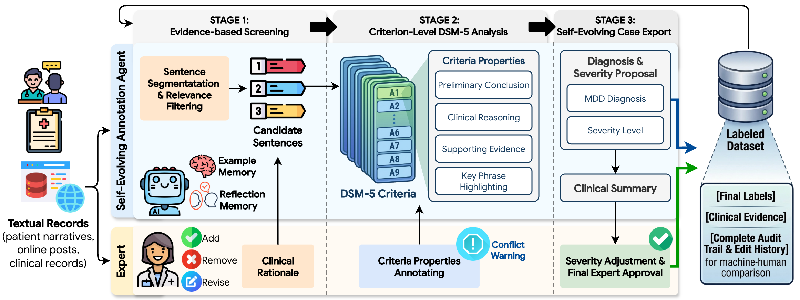
A groundbreaking study proposes a self-evolving annotation framework designed to improve the accuracy and explainability of mental health assessments, specifically for Major Depressive Disorder (MDD). Led by a team from the University of New Brunswick and VNU-HCM in Vietnam, this research addresses the pressing need for reliable depression symptom annotation in the age of artificial intelligence (AI).
The Challenge of Annotation Quality
Current practices for labeling depression symptoms often lack structured evidence and fail to align with established clinical guidelines. This makes them less reliable and harder to interpret. The research team identified that existing labels are frequently assigned without adequate justification, making it difficult for AI systems to provide trustworthy assessments. Their solution involves a unique framework that integrates AI assistance with human expert review.
A Three-Stage Process
The proposed framework operates in three distinct stages:
- Evidence-based Screening: The system filters raw textual records—like patient narratives—to highlight relevant symptoms without overwhelming the clinician.
- Criterion-Level Analysis: The AI examines this filtered evidence against the diagnostic criteria from the DSM-5-TR, providing a structured rationale for each potential diagnosis.
- Self-Evolving Case Export: Finally, it synthesizes a comprehensive patient profile while integrating feedback from human experts to continually enhance future annotations.
Innovative Memory Architecture
A significant innovation in this framework is its dual-memory architecture, dubbed Example Memory and Reflection Memory. These components allow the system not only to store correct examples but also to glean insights from expert feedback to refine future assessments without needing additional training sessions.
Results from Pilot Study
The framework was evaluated through a pilot study involving ten complex cases. Results showed strong agreement with expert assessments, achieving high precision and recall rates. For instance, the Gemini-3.5 model achieved a remarkable 99.1% precision in identifying clinically relevant evidence.
Additionally, using the framework substantially reduced the effort required from human annotators. Experts reported up to a 75% decrease in the time spent on annotation tasks, as the AI-generated drafts facilitated quicker reviews and corrections.
Implications for the Future
This self-evolving framework represents a significant leap forward in the integration of AI in mental health settings, blending the rigor of clinical practice with the scalability of advanced technology. The ongoing effort to adapt this framework for various mental health conditions promises a broader impact, possibly transforming the way mental health professionals approach diagnosis and treatment documentation.
This innovative approach highlights the importance of collaboration between AI and human expertise, paving the way for more reliable and transparent mental health assessments.
Authors: Hoang-Loc Cao, Van Pham, Truong Thanh Hung Nguyen, Phuc Truong Loc Nguyen, Phuc Ho, Veronica Whitford, Hung Cao.




