
Transforming Text Detection: MULTIGHOSTBENCH Sets a New Standard in Multilingual Authorship Attribution
In an era where large language models (LLMs) are capable of generating text that closely resembles human writing, the need for effective authorship attribution (AA) methods becomes increasingly crucial. A recent study introduces a groundbreaking benchmark known as MULTIGHOSTBENCH, which encompasses 928 books generated by five state-of-the-art LLMs across six languages. This innovative resource aims to enhance the robustness and effectiveness of text attribution, particularly in multilingual contexts.
The Need for MULTIGHOSTBENCH
The existing benchmarks for LLM authorship attribution have primarily been limited to English and shorter texts. They often fail to consider the nuanced challenges associated with text generated in different languages and under various distribution shifts. MULTIGHOSTBENCH addresses these issues by comprising an extensive collection of long-form texts (averaging approximately 59,000 words), thereby allowing for a more comprehensive evaluation of existing AA methods.
What Makes MULTIGHOSTBENCH Unique?
One of the principal features of MULTIGHOSTBENCH is its capacity to assess AA methods under different shifts—domain shifts (different genres), author shifts (unseen generators), and language shifts (cross-lingual evaluation). This means that researchers can measure how well their methods perform when faced with a text that may not conform to the patterns observed during training. The dataset's significant focus on long-form texts also acknowledges the shift towards longer content generated by LLMs.
Comparative Performance of Authorship Attribution Methods
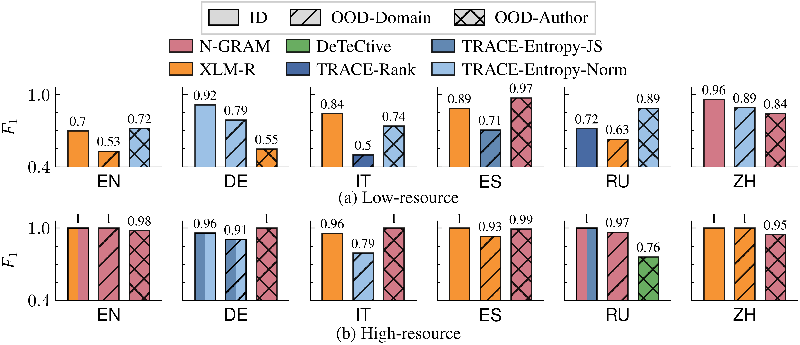
In conducting an evaluation of various AA techniques—from statistical to supervised learning—the study revealed a critical insight: no single method uniformly outperforms others across different languages and shift scenarios. For instance, transformer-based methods demonstrated higher performance in retaining generator-related information across languages, although their efficacy significantly fluctuated depending on the language pair involved.
Implications for Future Research
MULTIGHOSTBENCH stands to represent a substantial leap forward in the fields of text generation and detection. Its comprehensive nature allows for a diverse array of experiments, fostering the development of more sophisticated and adaptable AA methods. Researchers hope that this new benchmark will encourage further exploration into robust detection mechanisms—particularly as the digital landscape becomes increasingly populated by machine-generated content.
In Conclusion
As LLMs continue to advance, the challenges around authorship attribution grow in complexity. The introduction of MULTIGHOSTBENCH presents a significant milestone towards overcoming these obstacles by providing a valuable resource for evaluating and enhancing authorship attribution methods applicable across diverse languages and contexts.
Authors: {Matteo Greco, Anudeex Shetty, Andrea Tagarelli, Jey Han Lau}




