
Transforming Video Editing: How ViTeX-Bench Sets a New Standard for Accurate Scene Text Manipulation
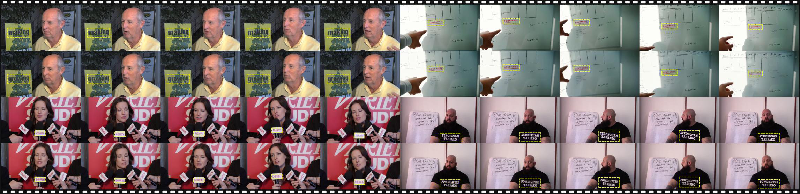
In the evolving landscape of video editing, the ability to manipulate text seamlessly within moving scenes has become a paramount challenge. A groundbreaking research paper from Xinghao Chen, Xiangbo Gao, Jiongze Yu, Yuheng Wu, and Zhengzhong Tu at Texas A&M University introduces ViTeX-Bench, a novel benchmark that promises to reshape high-fidelity video scene text editing.
The Challenge of Scene Text Editing
Traditional video editing often faces hurdles when it comes to maintaining the visual integrity and temporal consistency of edited text. Whether changing storefront signs or whiteboard notes, editors struggle to replace text while preserving motion and background features. Prior methods primarily focused on static images, leaving a significant gap for video editing tasks that demand high fidelity.
Introducing ViTeX-Bench
The ViTeX-Bench framework comprises a dataset of 387 real-world videos and a comprehensive evaluation protocol designed to assess text correctness, visual and temporal quality, and edit locality. This initiative addresses the pressing need for precise metrics that measure how effectively edited text can be rendered without disrupting the original scene’s dynamics.
Key Innovations of ViTeX-Bench
- ViTeX-Dataset: Containing 387 videos, the dataset features accurate text-region masks and specific editing instructions. It splits into two segments: a training set of 230 videos and a frozen evaluation set of 157 videos.
- Three-Axis Evaluation Protocol: The evaluation metrics focus on three critical areas: text correctness (accurate display of the target text), visual quality (maintaining a natural look), and edit locality (ensuring that unedited areas remain unchanged).
- ViTeX-Edit-14B Editor: As a practical embodiment of the research, this open-source video editor achieves the highest character accuracy among assessed native video editors, showcasing its ability to maintain both high-quality text rendering and temporal stability.
Experimental Success and Implications
Initial experiments demonstrate that while existing models achieved sporadic success in one metric (such as temporal stability), they struggled with character accuracy or maintaining the scene's overall integrity. The ViTeX-Edit-14B editor achieved a character accuracy (CharAcc) of 0.688, marking a significant improvement over its predecessors and establishing itself as a benchmark for future developments in video editing technology.
The Future of Video Editing
The introduction of ViTeX-Bench heralds a new era where video editing techniques can evolve to incorporate realistic text editing directly within dynamic scenes. Not only does it provide a reproducible framework for future studies, but it also sets the stage for advancements in tools enabling intuitive and polished video content creation.
With ViTeX-Bench, content creators, researchers, and developers now have a structured pathway to enhance the quality and accuracy of video scene text editing, promising a future filled with more engaging and visually coherent video narratives.


